
How to Stop a Boxer from Jumping on People
Your Boxer is airborne again. Sixty pounds of muscle and enthusiasm launching at every person who walks through the door. This is not a training failure — it is a very normal Boxer behavior that needs a very specific approach.
Why Jumping Shows Up Differently in Boxers
Most dogs jump as a greeting. Boxers jump as a full-body celebration. The difference matters because a Chihuahua who jumps is a minor annoyance. A Boxer who jumps can knock a child flat, bruise a guest, or send an elderly visitor to the hospital. The stakes are higher, which means the urgency is real.
Boxers jump for a specific reason: they are face-seekers. They want to get closer to your eyes, your mouth, your attention. This is deeply wired into the breed. Boxers were bred as companion dogs who form intense bonds with their people, and jumping is their way of closing the distance between you and them as fast as physically possible. They are not being rude. They are being Boxers.
The other factor is that Boxers mature slowly. Most breeds start settling out of puppy behaviors by 18 months. Boxers hold onto that puppy energy well past three years, sometimes longer. If you are waiting for your Boxer to outgrow jumping, you will be waiting a long time. For a deeper look at the breed's overall training needs, see our full Boxer training guide.
What Works for Boxers Specifically
The standard advice for jumping — turn away and ignore — is a starting point, but Boxers need more structure than that. Here is what actually works with this breed.
Train an incompatible behavior, not just the absence of jumping. Telling a Boxer "don't jump" leaves a vacuum. Telling a Boxer "sit when someone approaches" gives them a job. Practice the sit-to-greet protocol in low-excitement settings first. Have a family member walk through a door, ask for a sit, and reward generously when your Boxer holds it. Gradually increase the excitement level: faster entries, more animated greetings, multiple people. Your Boxer needs hundreds of reps before this becomes default behavior.
Use movement-based rewards, not just treats. Boxers are physical dogs. After a successful sit-to-greet, release your Boxer with a cue like "go say hi" and let them get their wiggles out at ground level. The greeting itself becomes the reward for the sit. This works better than food alone because the thing your Boxer actually wants is the social interaction, not the cookie.
Manage the environment while you train. Use a leash, a baby gate, or a tether point near the front door so your Boxer cannot practice jumping while you are building the new behavior. Every time your Boxer successfully jumps on someone, that behavior gets reinforced. Management prevents rehearsal while training builds the replacement. For a complete jumping protocol that pairs well with these Boxer-specific adjustments, see our greeting manners guide.
Labs share a similar jumping problem driven by the same social enthusiasm — our Lab jumping guide covers adjustments for that breed's specific build and temperament.
The Socialization Connection
Jumping often gets worse in dogs who are under-socialized because every new person is overwhelmingly exciting. A Boxer who meets new people regularly, in controlled settings, learns that greetings are normal events, not once-in-a-lifetime celebrations that require maximum effort.
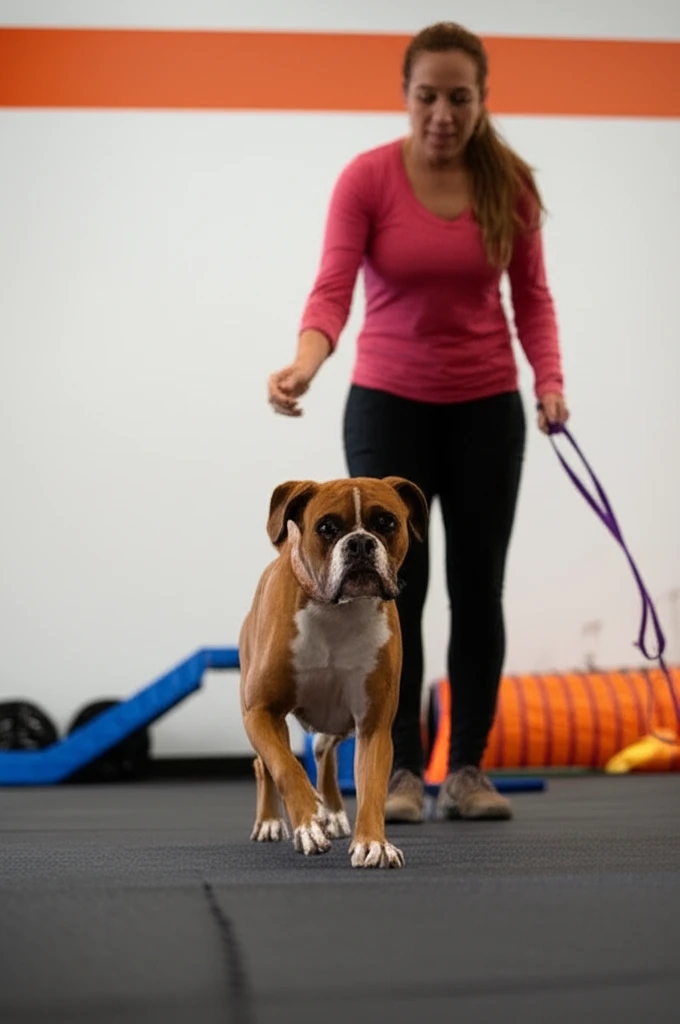
Structured socialization classes give your Boxer exactly this: repeated, managed exposure to new people and dogs in an environment where a trainer can help you reinforce calm behavior in real time. Your Boxer practices greeting people politely while you learn the timing and technique that make the training stick.
This is also where impulse control skills become critical. Jumping is fundamentally an impulse control problem. A Boxer who has learned to wait at doors, pause before meals, and settle on a mat has a foundation of self-regulation that transfers directly to greeting situations. Build those skills alongside the sit-to-greet protocol and you will see faster results than addressing jumping in isolation.
Find a Zoom Room near you to start working on your Boxer's greetings in a controlled, indoor environment where the temperature is comfortable and the distractions are managed.
Frequently Asked Questions
My Boxer only jumps on certain people. Why?
Your Boxer is reading the room. People who make high-pitched sounds, lean forward, or reach toward your dog are giving body language that invites jumping. People who stand still and stay quiet are less exciting. Coach your guests to stand tall, cross their arms, and avoid eye contact until your Boxer sits. The jumping stops when the invitation stops.
Is it okay to knee my Boxer in the chest when they jump?
No. Kneeing, pushing, or stepping on paws does not teach your Boxer what to do instead. Most Boxers interpret physical contact as play, which actually increases the jumping. Some Boxers will become anxious or fearful around greetings if physically corrected. Turning away and rewarding a sit is more effective and does not damage your relationship with your dog.
Ready to Fix the Jumping?
Zoom Room's group classes give your Boxer practice greeting real people in a structured setting with professional coaching. Indoor, climate-controlled, and designed for breeds who need to burn energy while learning manners.
Find a Zoom Room