
How to Train a Bull Terrier
A Bull Terrier will make you laugh every single day and question your training abilities just as often. This is a breed that combines genuine clownishness with bone-deep stubbornness, wrapped in a muscular body that does not quit. Training a Bull Terrier is an exercise in creativity, patience, and the willingness to be outsmarted occasionally.
Creative Motivation: The Key to a Bull Terrier's Brain
Bull Terriers are not unmotivated. They are selectively motivated. A training approach that relies on repetitive drills and the same treat every session will produce a Bull Terrier who checks out after three minutes and starts entertaining themselves, usually in ways you did not anticipate and will not enjoy. This breed needs variety, novelty, and the sense that training is a game worth playing.
Rotate your rewards constantly. Treats, toys, play, praise, and access to things your Bull Terrier wants. Figure out what lights your specific dog up and use it strategically. Some Bull Terriers are food-motivated. Others will work harder for a tug toy or a chance to chase a ball. Many respond best to a combination that changes session to session. The moment your training becomes predictable, your Bull Terrier will find something more interesting to do.
Keep sessions short and high-energy. Five to ten minutes of focused, engaging work produces better results than a twenty-minute session that your Bull Terrier mentally abandoned ten minutes ago. End every session before your dog wants to stop. Leave them wanting more, and they will show up to the next session ready to work. Positive reinforcement is the only approach that has traction with this breed. A Bull Terrier who feels pressured does not comply. They either escalate or disengage, and neither outcome moves you forward.
Socialization: Early, Often, and Carefully
Bull Terriers were originally bred for blood sport, and while modern Bull Terriers are far removed from that history, the breed retains a strong physical confidence and a play style that can be intense. Without proper socialization, that intensity can tip into reactivity, especially toward other dogs. Early socialization is not just recommended for this breed. It is essential.
Start socializing your Bull Terrier puppy during the critical window between 3 and 16 weeks. Expose them to dogs of various sizes and temperaments in controlled settings. Let them learn appropriate play skills: how to read body language, how to moderate their energy, how to disengage when the other dog is not interested. Bull Terriers play rough by nature, and a puppy who never learns that not every dog appreciates their style becomes an adult who starts conflicts.
After the socialization window, continue regular social exposure throughout your Bull Terrier's life. Structured group classes are far more valuable than dog parks for this breed, because the interactions are supervised and the energy level is managed. A professional trainer can redirect your Bull Terrier's intensity in the moment, before it becomes a pattern. If your Bull Terrier is already showing signs of leash reactivity, work with a trainer on desensitization at appropriate distances rather than forcing proximity that overwhelms your dog.
The Strong-Willed Factor
Bull Terriers are strong-willed in a way that goes beyond ordinary stubbornness. When a Bull Terrier decides they are not interested in what you are asking, they will ignore you with a completeness that is almost impressive. They are not being spiteful. They have simply decided, in that moment, that your request does not meet their cost-benefit threshold. Your job is to change that calculation, not to escalate the confrontation.
This means picking your battles wisely. Not every moment needs to be a training opportunity. If your Bull Terrier is in the middle of something they find intensely interesting, that is probably not the time to practice a new cue. Set yourself up for success by training when your dog is engaged, alert, and in an environment where you can compete with the distractions. Build a strong reinforcement history with basic cues in easy settings before asking for those cues in harder ones.
Impulse control exercises are particularly important for Bull Terriers because they build the habit of pausing before acting. Wait at doors. Leave-it with increasing difficulty. Sit before getting what they want. These exercises teach your Bull Terrier that self-regulation pays off, and a Bull Terrier who has internalized that lesson is dramatically easier to live with than one who acts on every impulse. The key is making the impulse control itself rewarding, not just the outcome. The game is the pause. The reward is what comes after.
Destructive Chewing and the High Pain Tolerance Problem
Bull Terriers have a high pain tolerance and powerful jaws. That combination means they can chew through things that would deter other breeds, and they may not show obvious signs of discomfort when teething or stressed. Destructive chewing is a common complaint with Bull Terriers, and it often stems from boredom, understimulation, or the simple fact that chewing is deeply satisfying for a dog with this jaw structure.
Prevention is more effective than correction. Provide appropriate, durable chew outlets at all times. Kongs, Nylabones, and other heavy-duty chew toys give your Bull Terrier a legal target for their chewing drive. Manage the environment by keeping tempting items out of reach, especially during puppyhood and adolescence. A Bull Terrier who has access to both a shoe and a Kong will often choose the shoe, so remove the choice.
Mental enrichment reduces destructive behavior by addressing the underlying boredom that drives it. Puzzle feeders, frozen Kongs, scatter feeding, and training games give your Bull Terrier's brain something to work on. A mentally stimulated Bull Terrier is less likely to redecorate your furniture. A bored Bull Terrier is guaranteed to find their own entertainment, and their creativity in that department is genuinely remarkable.
Channeling the Clown
Bull Terriers are funny dogs. They spin, they zoom, they do things with their bodies that seem to defy physics, and they seem to know exactly when they are being entertaining. This clownishness is one of the breed's most endearing qualities, and it is also a training asset if you know how to use it.
Trick training is a natural fit for Bull Terriers. Spin, roll over, play dead, weave between your legs. These are not just party tricks. They are structured activities that channel your Bull Terrier's physical energy and desire for attention into specific, rewarded behaviors. A Bull Terrier who has a repertoire of tricks has a constructive way to show off, and showing off with tricks is far more pleasant than showing off by stealing your socks and running a victory lap through the house.
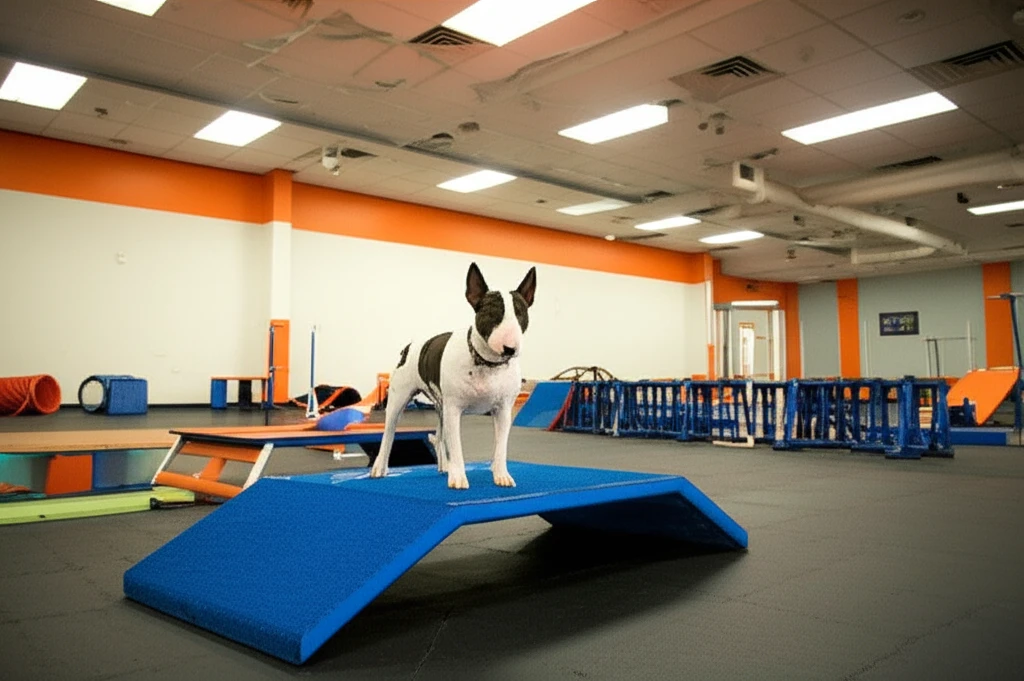
Agility is another excellent outlet for this breed. The combination of physical challenge, mental engagement, and handler partnership keeps a Bull Terrier engaged in a way that simple obedience drills cannot. The variety of obstacles and the fast pace of the activity matches the Bull Terrier's energy level, and the teamwork aspect builds the kind of connection that makes everyday training easier.
At Zoom Room, our training programs provide the variety and structure that Bull Terriers need to stay engaged. From trick training to agility to structured socialization, we offer the kind of varied, upbeat training environment where Bull Terriers actually want to participate. Find a Zoom Room near you and put your Bull Terrier's energy to work.
Frequently Asked Questions
Are Bull Terriers aggressive?
Bull Terriers are not inherently aggressive, but they are strong, confident dogs with intense play styles and a history that includes blood sport. Without proper socialization, some Bull Terriers can develop reactivity toward other dogs. Early, consistent socialization and positive training methods produce stable, well-adjusted Bull Terriers. The breed's reputation for toughness often overshadows their genuine affection for people. A well-socialized, well-trained Bull Terrier is goofy, loyal, and remarkably good with their family. The key is investing in socialization during puppyhood and maintaining it throughout the dog's life.
How do I keep my Bull Terrier from getting bored?
Variety is the answer. Bull Terriers are intelligent dogs who get bored quickly with repetition. Rotate toys regularly so there is always something novel. Use puzzle feeders and enrichment toys for meals instead of a bowl. Incorporate training games, trick training, and activities like agility into your routine. Physical exercise alone is not enough. A Bull Terrier needs their brain engaged as much as their body. Plan for at least one structured mental activity per day, whether that is a training session, a puzzle toy, or a scent game. A bored Bull Terrier will always find their own entertainment.
Are Bull Terriers good family dogs?
Bull Terriers can be wonderful family dogs. They are affectionate, playful, and often excellent with older children who can match their energy. Their clownish personality makes them entertaining companions. The considerations are their strength, their intense play style, and their need for consistent training. Very young children should always be supervised around any dog this strong. Bull Terriers do best in active households that can provide daily mental and physical stimulation, consistent training, and the social interaction this people-oriented breed craves.
Ready to Get Started?
Zoom Room's training programs offer the variety and energy that Bull Terriers thrive on. From agility to trick training, we keep your Bull Terrier engaged, socialized, and channeling all that personality into real skills.
Find a Zoom Room