
Chihuahua Fear and Anxiety: Why Your Dog Is Scared, Not Mean
Your Chihuahua is not aggressive. They are not dominant. And "small dog syndrome" is not a real diagnosis — it is a label people use to avoid addressing what is actually happening: your dog is afraid, and nobody taught them not to be.
Why Fear Shows Up Differently in Chihuahuas
Every dog breed can develop fear-based behavior when socialization is inadequate. But Chihuahuas get hit from two directions at once. First, they live in a world that is physically overwhelming. Other dogs are five, ten, twenty times their size. Human feet land near them like falling trees. Doorways, stairs, sidewalk grates, and everyday objects are scaled for animals much larger than they are. The world is legitimately more intimidating when you weigh six pounds.
Second — and this is the bigger factor — Chihuahuas are systematically denied the socialization experiences that would teach them the world is safe. Owners carry them past challenges, scoop them up at the first sign of discomfort, and skip training classes because the dog is small enough to manage physically. Every time you pick up your Chihuahua instead of letting them work through a moment of uncertainty, you confirm their suspicion that the thing was worth being afraid of.
The result is a dog whose fear responses look like aggression: barking, snapping, lunging, trembling, showing teeth. These are not signs of a dog trying to control their environment. They are signs of a dog trying to survive it. Your Chihuahua has learned that making themselves loud and scary is the only strategy that creates distance from threats. For a deep dive into how fear drives these behaviors across all breeds, our fearful dogs guide covers the full picture.
What Works for Chihuahuas Specifically
The single most important shift is to stop managing fear and start resolving it. That means your Chihuahua stays on the ground, walks on their own feet, and encounters the world as a dog — not as a handbag accessory. This does not mean flooding them with scary experiences. It means structured, gradual exposure at a pace your dog can handle.
Start with distance. Find the point where your Chihuahua can notice a trigger — another dog, a stranger, a new sound — without panicking. That is your working distance. At that distance, pair the trigger with something your dog loves: small, high-value treats delivered one after another while the trigger is visible. You are building a new emotional association. The stranger used to predict danger. Now the stranger predicts chicken.
Chihuahuas have a few specific training needs that differ from larger fearful dogs. Their threshold distance is often much greater than you expect. A dog who weighs six pounds may need 30 or 40 feet from a trigger that a 60-pound dog could handle at ten feet. Respect that. Pushing too close too fast sets the training back, not forward. Also, reward delivery matters — use tiny, soft treats your Chihuahua can eat without stopping to chew, and deliver them low, near ground level, so your dog does not have to jump or strain to reach your hand.
Avoid the temptation to comfort your dog verbally during fear responses. Soothing words in a worried tone can reinforce the emotional state you are trying to change. Instead, be calm, matter-of-fact, and focused on the mechanics: distance, treats, short sessions, always ending before your dog hits their limit. For related approaches to confidence building around other dogs specifically, see our guide on adult dog socialization.
The Socialization Connection
Fear in Chihuahuas is overwhelmingly a socialization deficit, not a breed destiny. Research consistently shows that small dogs receive less training and less socialization than larger dogs, and that this gap — not genetics — accounts for the majority of fear-based behavior in small breeds. Chihuahuas are not born nervous. They are made nervous by an environment that fails to teach them confidence.
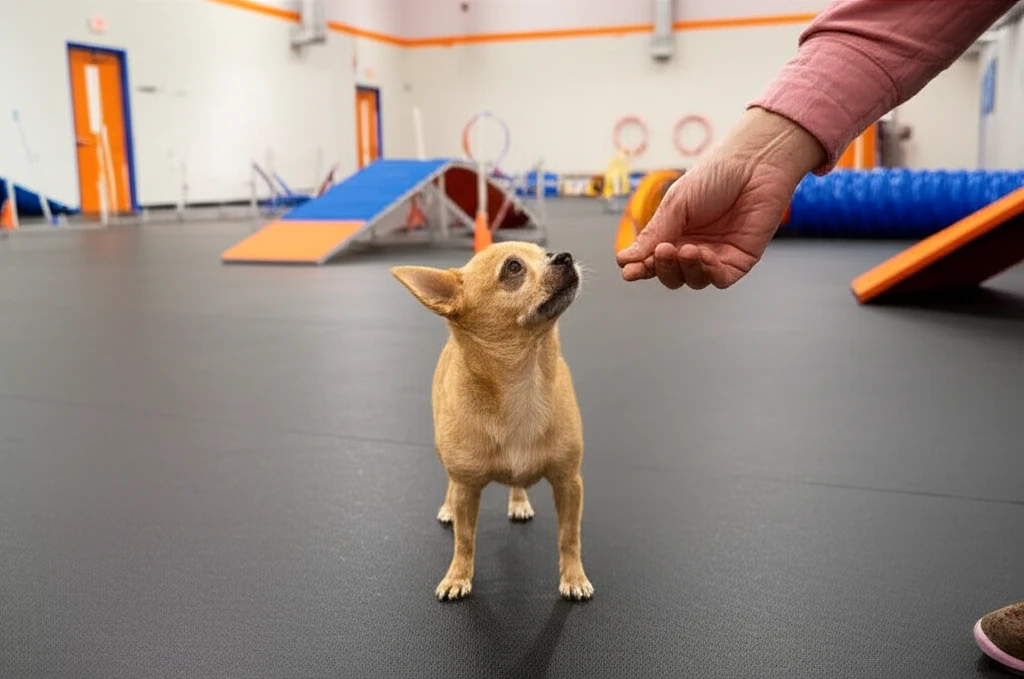
If you have a Chihuahua puppy, socialization is the single most important thing you can do. More important than any obedience cue. Expose your puppy to a wide range of people, dogs, surfaces, sounds, and environments during the critical window before 16 weeks. Let them walk on their own feet. Let them approach new things at their own pace. Reward curiosity. Never force an interaction. A structured puppy socialization program in a controlled indoor environment is ideal because the trainer manages the intensity and your puppy gets to practice being brave in a setting that is genuinely safe.
If your Chihuahua is already an adult with established fear responses, the same principles apply — the timeline is just longer. Adult dogs can absolutely learn new emotional responses to things that currently frighten them. It takes patience, consistency, and a willingness to move at your dog's pace rather than yours. Group classes in an indoor facility like Zoom Room are particularly valuable because your Chihuahua gets regular, predictable exposure to other dogs and people in a managed environment. Over weeks of positive experiences, the fearful dog who trembled at the door starts walking in with their tail up.
The myth of "small dog syndrome" does real harm because it tells owners that fear and reactivity are just how Chihuahuas are. They are not. Your Chihuahua is capable of confidence, calm, and genuine enjoyment of the world — but only if you give them the tools to get there. At Zoom Room, our training programs treat every dog as a dog, regardless of size. Find a location near you and start building the confidence your Chihuahua deserves.
Frequently Asked Questions
Is small dog syndrome a real thing?
No. Small dog syndrome is not a recognized behavioral diagnosis. It is a casual label applied to small dogs who display fear-based reactivity — barking, snapping, lunging — that would be taken seriously in a larger breed but gets dismissed as a personality quirk in a six-pound dog. The behaviors people attribute to small dog syndrome are almost entirely the result of inadequate socialization and training. Small dogs receive less training than large dogs on average, and their owners are more likely to manage behavior through avoidance (carrying, picking up) than through actual behavior modification. The dog is not wired to be difficult. The dog was never taught not to be afraid.
Can an adult Chihuahua who is already fearful learn to be confident?
Yes. Adult dogs can form new emotional associations at any age. The process is slower than with a puppy because you are overwriting existing fear responses rather than building on a blank slate, but the mechanics are the same: controlled, gradual exposure to triggers paired with high-value rewards, always at a distance where the dog can stay below their panic threshold. Consistency and patience are essential. Many Chihuahua owners see meaningful improvement within a few weeks of daily practice, and significant transformation over two to three months. Structured group classes accelerate the process because they provide regular, predictable social exposure in a safe environment.
Your Chihuahua Deserves Better Than Fear
Zoom Room's indoor training facility gives Chihuahuas the structured, positive socialization they need to build real confidence. No carrying, no excuses — just a dog learning to be brave.
Find a Zoom Room