
How to Train a German Shorthaired Pointer (Give Them a Job or They'll Find One)
The German Shorthaired Pointer is one of the most versatile sporting breeds ever developed -- built to point, retrieve, track, swim, and run all day over any terrain. That's the breed you brought home. And if you don't give all that ability somewhere to go, it will go into your furniture, your shoes, your yard, and your sanity.
What Makes GSPs Different to Train
German Shorthaired Pointers are not difficult to train. They're actually eager learners with strong handler orientation and a genuine desire to work. The challenge isn't motivation -- it's energy management. A GSP who hasn't had enough physical and mental outlet on a given day is a GSP who can't hold still long enough to learn anything. The prerequisite to every training session is a dog who's had enough exercise to think clearly.
This is a breed that was designed to work a full day in the field -- covering miles, making decisions, responding to handler signals at a distance, and maintaining focus through changing conditions. That drive and stamina don't disappear because you live in a suburb. A 20-minute walk around the block isn't exercise for a GSP. It's a warm-up. The dog needs real physical output before you can expect real mental engagement.
Once that energy is addressed, GSPs are remarkably trainable. They're sensitive to handler cues, responsive to positive reinforcement, and genuinely eager to please. They read your body language with an athlete's awareness and respond to subtle signals that other breeds would miss entirely. This sensitivity is a training asset -- but it also means harsh corrections damage the partnership quickly. A GSP who's been physically punished or yelled at doesn't get tougher. They get anxious, and an anxious GSP with this much energy is a genuinely difficult dog to live with.
The other defining trait is impulse control -- or rather, the lack of it. GSPs are bred to react instantly to movement: a bird flushing, a rabbit breaking cover, a scent trail going hot. That reactivity is a feature in the field and a liability in daily life. Teaching a GSP to pause, to wait, to choose not to chase -- this is the core training challenge, and it's one that pays dividends across every aspect of living with this breed.
The Impulse Control Project
If you train a GSP in one thing beyond basic obedience, make it impulse control. This single skill set transforms a reactive, hard-to-manage dog into one who can actually participate in normal life.
Wait at thresholds. Every door, every gate, every car door becomes a training opportunity. Your GSP doesn't blast through until released. This teaches the fundamental concept that exciting things happen after a moment of self-control, not instead of it.
Wait for food. Bowl goes down, dog waits for the release cue. Start with one second. Build to five, then ten. The impulse to dive at food is strong in GSPs, and overriding it builds the neural pathways for overriding other impulses too.
Leave it -- for real. Not just leaving a treat on the floor. Leave the squirrel. Leave the jogger. Leave the other dog. Build "leave it" from easy (treat on the floor in a quiet room) to hard (moving distraction outdoors) in gradual stages. This cue will be the most useful thing in your GSP's vocabulary, and it needs to be rock-solid.
Recall under distraction. A GSP recall needs to compete with every bird, squirrel, and interesting scent in the environment. Build it with extremely high-value rewards and practice in progressively more distracting settings. Use a long line in unfenced areas until the recall is reliable -- and with a GSP, "reliable" means tested against real-world distractions, not just practiced in the backyard.
Where GSPs Typically Need Work
- Jumping. GSPs are tall, athletic, and express excitement vertically. They jump on people, they jump on counters, they jump fences. Teaching an incompatible behavior (sit to greet, four on the floor) needs to start early and be reinforced by every person who interacts with the dog.
- Pulling on leash. A GSP on a leash is a sprinter in a phone booth. They want to go faster, they want to go further, and they have the physical strength to drag most people. Loose-leash walking is achievable but requires consistent reinforcement that staying beside you is more rewarding than pulling ahead.
- Chasing. Cats, squirrels, birds, joggers, cyclists, blowing leaves -- anything that moves can trigger the chase instinct. Management (leash, long line, fenced areas) combined with strong "leave it" and recall training is the approach. Complete suppression of prey drive isn't realistic with this breed, but reliable redirection is.
- Destructive behavior when bored. A GSP without enough stimulation will dismantle your home with impressive efficiency. This isn't spite -- it's a working brain with nothing to work on. The solution is always more enrichment, not more confinement.
- Separation anxiety. GSPs bond intensely with their people and some struggle with being alone. Gradual acclimation to alone time, plenty of exercise before departures, and enrichment toys (puzzle feeders, stuffed Kongs) help manage this.
What Actually Works
Exercise first, train second. A GSP who hasn't burned off physical energy cannot focus. Period. Run them, swim them, play intense fetch, let them sprint in a fenced area -- then train. The training session after 30 minutes of hard exercise will be three times more productive than the one you attempt with a dog who's been lying around all morning.
Give them a sport. Agility, nose work, dock diving, rally obedience -- GSPs excel at all of these because each one combines physical output with mental problem-solving. A GSP with a regular training sport is a fundamentally different dog than one without. The sport doesn't just tire them out -- it gives their considerable abilities a sanctioned outlet and deepens your partnership.
Use their sensitivity. GSPs are highly attuned to your body language and tone. A slight change in your posture can communicate as much as a verbal cue. Use this. Develop subtle signals for frequently used cues. The less you need to shout, the more responsive your GSP becomes -- because they're already watching you closely and reading every signal you send.
Socialize the intensity. GSPs play hard, and their play style -- fast, physical, mouthy -- can overwhelm dogs who didn't sign up for that level of enthusiasm. Structured socialization teaches your GSP to read other dogs' signals and moderate their approach. A well-socialized GSP can match their energy to their playmate. An under-socialized one barrels through every interaction at full speed.
Rotate enrichment. The same puzzle toy every day stops being enriching. Rotate toys, change up training games, introduce new challenges regularly. GSPs are smart enough to solve most food puzzles quickly, so you need to stay one step ahead. Frozen Kongs, snuffle mats, scent trails through the house, new trick training -- keep the mental menu varied.
The Bigger Picture
The GSP owner who thrives isn't necessarily the one with 40 acres and a hunting lease. It's the one who understands that this breed needs a structured outlet for their energy and intelligence -- and who commits to providing it, consistently, for the life of the dog. That might be daily runs plus weekend agility. It might be morning swims plus evening training sessions. The specifics matter less than the commitment.
A well-trained GSP with adequate exercise and mental stimulation is one of the best dogs you can own. They're loyal without being clingy, athletic without being hyperactive, sensitive without being fragile, and versatile enough to excel at almost anything you ask them to do. The same drive that makes an under-stimulated GSP so difficult makes a well-managed one extraordinary.
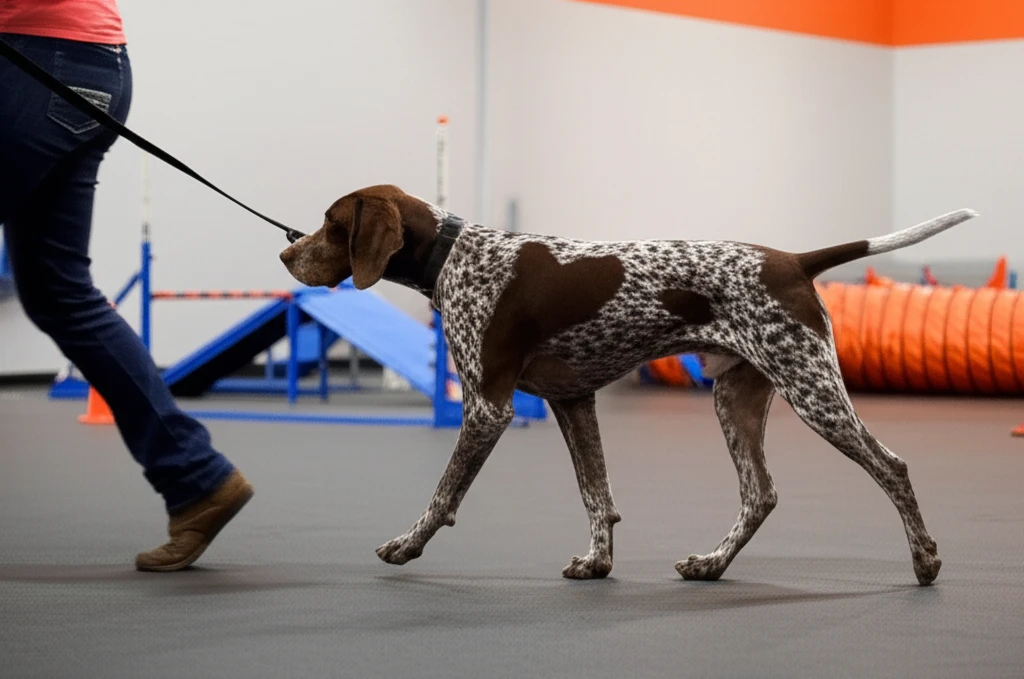
Group classes are particularly effective for this breed because they combine obedience training with socialization in a structured environment that demands exactly the kind of focus and impulse control GSPs need to develop. Learning to hold a stay while another dog runs an agility course ten feet away is the real-world impulse control training that transforms this breed from a beautiful handful into a remarkable partner.
Frequently Asked Questions
How much exercise does a German Shorthaired Pointer need?
GSPs typically need one to two hours of vigorous exercise daily -- not just walking, but running, swimming, fetching, or other high-intensity activity. A 20-minute stroll around the block is a warm-up, not a workout, for this breed. Beyond physical exercise, they also need mental stimulation through training, puzzle toys, scent games, or a structured sport like agility or nose work. A GSP who gets both physical and mental outlets is calm and focused at home. One who doesn't will find their own entertainment, and you probably won't like their choices.
Are GSPs good family dogs?
GSPs can be wonderful family dogs for active households that can meet their exercise and training needs. They're affectionate, loyal, and generally good with children who are old enough to handle an enthusiastic, high-energy dog. The key is providing enough physical and mental outlet so your GSP is calm and settled at home rather than bouncing off the walls. Families who enjoy hiking, running, or outdoor activities often find that a GSP is the perfect companion for their lifestyle.
Why is my GSP so destructive when left alone?
Destructive behavior in a GSP almost always points to insufficient exercise, mental stimulation, or both. This breed was designed to work all day, and a bored GSP with pent-up energy will redirect that drive into chewing, digging, or dismantling household items. The solution is to increase exercise before you leave, provide enrichment activities like stuffed Kongs or puzzle feeders, and build up alone time gradually. If the destructive behavior is accompanied by signs of panic, your GSP may be experiencing separation anxiety, which benefits from a structured training plan.
Give Your GSP a Job
Agility, obedience, nose work -- our classes channel that legendary GSP energy into skills you'll both enjoy.
Find a Zoom Room