
How to Train a Golden Retriever (The Easiest Hard Work You'll Ever Do)
Golden Retrievers have a reputation for being the "easy" breed. And compared to, say, a Husky or a Malinois, sure. But "easy to train" and "already trained" are very different things. An untrained Golden is still 65 pounds of unbridled enthusiasm that jumps on every person, pulls toward every dog, and retrieves things you never asked for.
What Makes Goldens Different to Train
Golden Retrievers are one of the few breeds where praise genuinely moves the needle. Most dogs will work for food. Goldens will work for food and your approval, and the combination of both is where training really clicks. A well-timed "good dog" paired with a treat lands harder with a Golden than with almost any other breed.
They're also what trainers call a "soft" breed. Harsh corrections, raised voices, leash pops--these don't toughen a Golden up. They shut a Golden down. You'll see it immediately: ears back, tail low, avoidance behavior. The dog isn't being stubborn. The dog is confused about why you're upset, and confusion makes learning impossible. Positive reinforcement isn't just the ethical choice with this breed--it's the only approach that consistently works.
Because Goldens are a retrieving breed, mouthiness comes with the territory. Puppies will mouth your hands. Adolescents will carry socks, shoes, and TV remotes around the house. This is normal breed behavior, not defiance. The goal isn't to eliminate the carrying instinct--it's to redirect it toward appropriate items and teach a reliable "drop it."
Goldens are also deeply social dogs. They want to greet every person and every dog they encounter, which is wonderful for temperament but creates real impulse control challenges. They need to learn that being friendly and being polite are two different skills. The friendliness is built in. The politeness requires training.
One trait that often surprises new Golden owners: these dogs need mental stimulation, not just physical exercise. A tired Golden who got a two-hour walk but no brain work will still find ways to entertain themselves--and their ideas of entertainment rarely align with yours. Structured training sessions, scent work, puzzle toys, and trick training all give their active minds something productive to do.
Where Goldens Typically Need Work
- Jumping on people. Goldens are SO happy to see everyone. Every person is the best person they've ever met, and their default greeting is full-body contact. This is the single most common behavioral complaint from Golden owners.
- Pulling on leash. They want to get to people and dogs as quickly as possible. Loose-leash walking requires teaching them that pulling actually slows their progress toward the thing they want.
- Mouthing and carrying. Puppies mouth hands during play. Adults carry objects around constantly. Redirect to appropriate chew toys and teach "drop it" and "leave it" early.
- Over-excitement in social situations. Dog parks, pet stores, group classes--anywhere with other dogs or new people can trigger over-the-top excitement. Structured socialization teaches them to be calm in these environments.
- Separation anxiety. Goldens bond deeply with their people. Some struggle when left alone, especially if they weren't gradually acclimated to alone time as puppies. This is a people-attached breed, and independence needs to be taught, not assumed.
- Counter-surfing. They're tall enough to reach kitchen counters and food-motivated enough to try. Management (keeping counters clear) combined with a strong "leave it" cue is the solution.
What Actually Works
Combine verbal praise with food rewards. With most breeds, the food does the heavy lifting. With Goldens, your voice matters. A flat, mechanical "good" followed by a treat gets results. An enthusiastic, genuine "YES, good dog!" followed by a treat gets dramatically better results. Use both channels.
Teach calm greetings early. "Sit to say hi" should become your Golden's default behavior around new people. Start practicing at home with family members before expecting it with strangers. The rule is simple: four paws on the floor gets attention, jumping makes the person turn away. Every person your dog meets needs to follow the same protocol, or the training won't stick.
Channel the retrieve drive. Instead of fighting your Golden's instinct to carry things, use it. Fetch becomes a training reward. "Bring me your toy" becomes a useful cue. Structured retrieval games build impulse control, teach patience (waiting for the throw), and give the dog an outlet for breed-specific behavior.
Socialize early and consistently. Goldens are naturally social, which is an enormous advantage--but natural sociability without structure produces a dog who drags you toward every dog at the park. Early socialization teaches your Golden that other dogs and people are normal parts of life, not exciting events that require a meltdown.
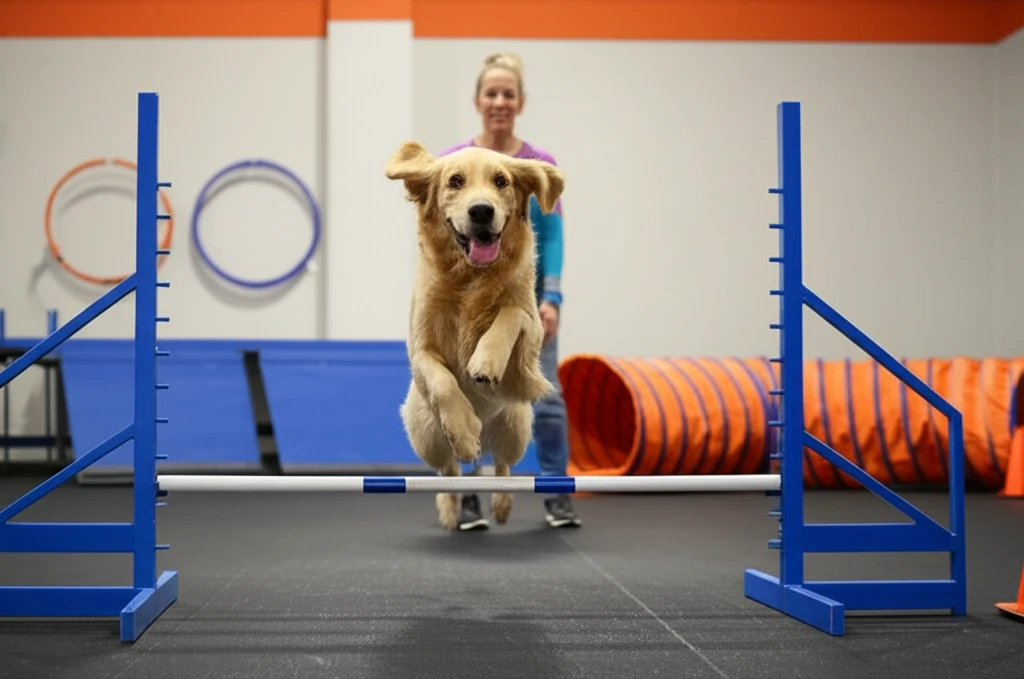
Give their brain a job. Agility, trick training, scent work, rally obedience--Goldens excel at all of these because they combine physical activity with problem-solving. A Golden with a job is a happy Golden. A Golden without one will create their own job description, and it usually involves destroying something.
Be consistent across all family members. Goldens are perceptive. They learn quickly who enforces rules and who doesn't. If one person lets the dog on the couch and another doesn't, the dog will simply jump on the couch when the permissive person is around. Everyone in the household needs to follow the same rules, use the same cues, and reinforce the same behaviors.
The Bigger Picture
A well-trained Golden Retriever is the ultimate family dog, therapy dog, and adventure companion. They're the breed that makes strangers smile on walks, that children gravitate toward at the park, that welcome your guests without bowling them over. That dog doesn't happen by accident. It happens because someone invested the time.
The good news is that Goldens want to do the right thing. They aren't testing you. They aren't being dominant. They're enthusiastic dogs who need someone to show them what "the right thing" looks like in each situation. Your job as their trainer is to be that guide--clearly, consistently, and with a lot of treats and praise along the way.
Group classes are particularly valuable for Goldens because they leverage the breed's natural sociability. Learning to focus on you while surrounded by other dogs and people is exactly the skill most Goldens need to develop. It's controlled exposure to their biggest distractions, with a professional there to help you navigate it.
The first two years are the investment. Puppy kindergarten, basic obedience, adolescent refreshers, maybe agility or tricks for enrichment. After that, you have 10-12 years with a dog who walks politely, greets people calmly, comes when called, and still lights up every room with that unmistakable Golden enthusiasm--just with a little more self-control.
Frequently Asked Questions
How much exercise does a Golden Retriever need daily?
Most Golden Retrievers need about 60 to 90 minutes of exercise per day, but physical activity alone is not enough. Goldens also need mental stimulation through training sessions, puzzle toys, scent work, or trick training. A Golden who gets a long walk but no brain work will still find ways to burn off mental energy, often by chewing or getting into things around the house. The best approach combines physical exercise with structured mental challenges spread throughout the day.
At what age should I start training my Golden Retriever puppy?
Start training the day your Golden Retriever puppy comes home, which is typically around eight weeks old. Puppies are ready to learn basic cues like sit, name recognition, and following a lure right away. Early socialization -- exposing your puppy to different people, dogs, sounds, and environments -- should also begin immediately and continue through at least 16 weeks. The earlier you start building good habits and impulse control, the easier adolescence will be with this energetic breed.
Why does my Golden Retriever mouth and carry everything?
Golden Retrievers were bred to retrieve game, so carrying things in their mouth is deeply satisfying breed-specific behavior. Puppies will mouth hands during play, and adults will walk around with shoes, toys, or anything they can pick up. This is not defiance or bad behavior. Instead of trying to stop the instinct entirely, redirect it toward appropriate items. Teach a reliable "drop it" cue, provide plenty of approved chew toys, and use fetch as a training reward. A Golden with something appropriate in their mouth is a happy Golden.
Train With Their Pack
Golden Retrievers thrive in group classes where their natural sociability becomes a training advantage.
Find a Zoom Room