
Goldendoodle Leash Pulling: Why Doodles Pull So Hard and What Actually Works
Leash pulling is the number one complaint from Goldendoodle owners, and it is not even close. Your Doodle combines retriever enthusiasm with Poodle athleticism in a 50-to-75-pound body that can make every walk feel like you are being towed behind a very friendly truck.
Why Leash Pulling Shows Up Differently in Goldendoodles
Goldendoodles pull for specific genetic reasons that make the problem more persistent than in many other breeds. Golden Retrievers are forward-moving dogs bred to charge into fields and water to retrieve game. They are hardwired to move toward interesting things with enthusiasm. Poodles contribute endurance, athleticism, and enough intelligence to figure out that pulling works. When your dog lunges toward a squirrel and you take three stumbling steps forward, your Goldendoodle has just learned that pulling produces results.
What makes Goldendoodle pulling particularly tricky is the variability in the cross. Some Doodles pull with classic retriever exuberance — joyful, oblivious, dragging you toward every person and dog because they want to say hello to everyone on the planet. Others pull with Poodle-side intensity — more focused, more athletic, harder to interrupt because they are genuinely locked onto a target. Your training approach needs to match which style of pulling your specific dog does.
There is also a size problem that Goldendoodle owners underestimate. A Standard Goldendoodle is strong. Genuinely strong. Many owners adopted a fluffy puppy and did not anticipate having a muscular 65-pound dog at the other end of the leash within a year. By the time the pulling becomes a real safety issue, it has already been reinforced on hundreds of walks. For more on the general mechanics of why dogs pull and how to address it, see our full guide on loose leash walking.
What Works for Goldendoodles Specifically
Standard loose leash training principles apply to every breed, but Goldendoodles need a few specific adjustments. First, use a front-clip harness from the start. Your Goldendoodle is strong enough to pull through a flat collar without noticing, and a front-clip harness redirects that forward momentum into a turn, mechanically reducing the force without any discomfort. This is not a solution by itself, but it keeps you upright while you train.
Second, lean into your Goldendoodle's food motivation. Most Doodles are intensely food-driven — this is the retriever side talking. Use that. Carry high-value treats on every walk and reward generously when your dog is in the reward zone beside you. Early in training, you may be treating every three to five steps. That rate will feel excessive and it is exactly right. You are competing with squirrels, other dogs, and every interesting smell on the sidewalk. Your treats need to outbid the environment.
Third, address the social pulling separately. If your Goldendoodle's worst pulling happens when they spot another dog or person, that is not just a leash mechanics problem — it is an impulse control issue. Practice the "look at that" technique: when your dog spots a trigger, mark the moment they look at it, then reward them for turning back to you. Over time, your Goldendoodle learns that seeing another dog predicts a treat from you, not a chance to lunge and greet.
Fourth, consistency across your household is non-negotiable. Goldendoodles are smart enough to learn that one person enforces the rules and another does not. If pulling works with any family member on any walk, the behavior persists. Everyone who walks your dog must follow the same protocol: stop when the leash goes tight, reward when it is loose, never allow pulling to produce forward motion. For dogs who also show signs of frustration or barking on leash, our leash reactivity guide covers the next level of training.
The Socialization Connection
Many Goldendoodles pull because they are over-aroused by the world, and that over-arousal is often a socialization issue. A dog who has had extensive, positive exposure to different environments, people, and other dogs is less likely to be overwhelmed by every walk. The world is familiar, so there is less to lunge toward.
A Goldendoodle who missed critical socialization or who only experienced unstructured social situations — like chaotic dog parks — may pull because every outing feels like a high-stakes event. Structured socialization in a controlled environment teaches your dog that the world is interesting but manageable. They learn to observe without exploding toward every stimulus.
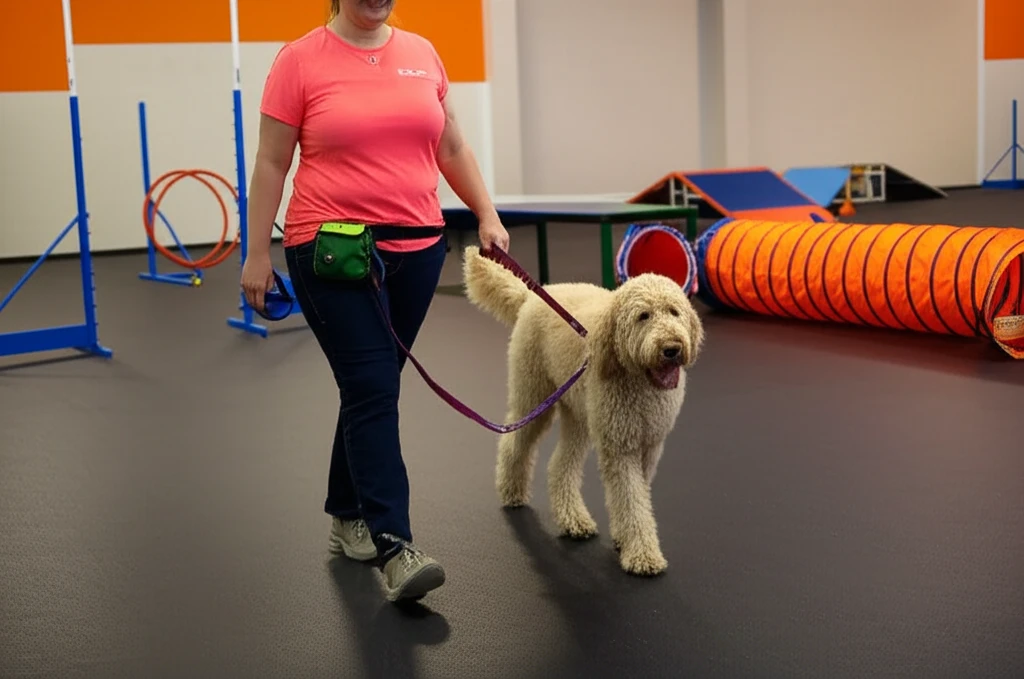
This is where group training classes pay double dividends. Your Goldendoodle practices loose leash walking inside a facility with other dogs present, which is exactly the distraction that causes pulling on real walks. They learn that other dogs nearby does not mean it is time to drag you across the room. Over weeks of practice, that calm-around-distractions skill transfers to the sidewalk, the park, and everywhere else you walk together.
If your Goldendoodle is an adult who still pulls on every walk, it is not too late. The same techniques work on dogs of any age — adult dogs simply have more practice pulling, so the retraining takes more repetitions. A Great Dane who pulls is a safety emergency; a Goldendoodle who pulls is an exhausting daily struggle. Either way, the fix is the same: make walking beside you more rewarding than pulling ahead. At Zoom Room, our obedience classes teach this as a core skill in an indoor gym where your trainer can coach your timing and leash mechanics in real time. Find a Zoom Room near you to get started.
Frequently Asked Questions
Why does my Goldendoodle pull so much harder than other dogs?
Goldendoodles inherit forward momentum from their Golden Retriever side and sustained athletic energy from their Poodle side. Combined in a 50-to-75-pound dog, that produces pulling force that many owners are genuinely unprepared for. The pulling is also often reinforced by social motivation — your Doodle wants to greet every person and dog they see, and every time pulling brings them closer to a greeting, the behavior gets stronger. A front-clip harness, consistent stop-and-wait training, and high-value rewards for walking beside you are the most effective combination.
At what age should I start leash training my Goldendoodle?
Start on your first walk. Every walk where your puppy is allowed to pull teaches them that pulling works. At eight to twelve weeks, your Goldendoodle is small enough that pulling is not a physical problem for you, which is exactly why most owners let it slide. But you are setting a habit that becomes exponentially harder to change as your dog grows. Use a properly fitted harness, keep walks short, and reward your puppy every few steps for staying near you. The investment at eight weeks prevents the tug-of-war at eight months.
Tired of Being Pulled Down the Street?
Zoom Room's obedience classes teach loose leash walking alongside other dogs, so your Goldendoodle learns to stay calm and walk beside you even with real-world distractions present.
Find a Zoom Room