
Great Dane Leash Pulling: When Size Makes It a Safety Issue
When a 30-pound dog pulls on the leash, it is annoying. When a 150-pound Great Dane pulls on the leash, it is a trip to the emergency room. The mechanics of leash pulling change completely when your dog outweighs you, and the margin for error disappears.
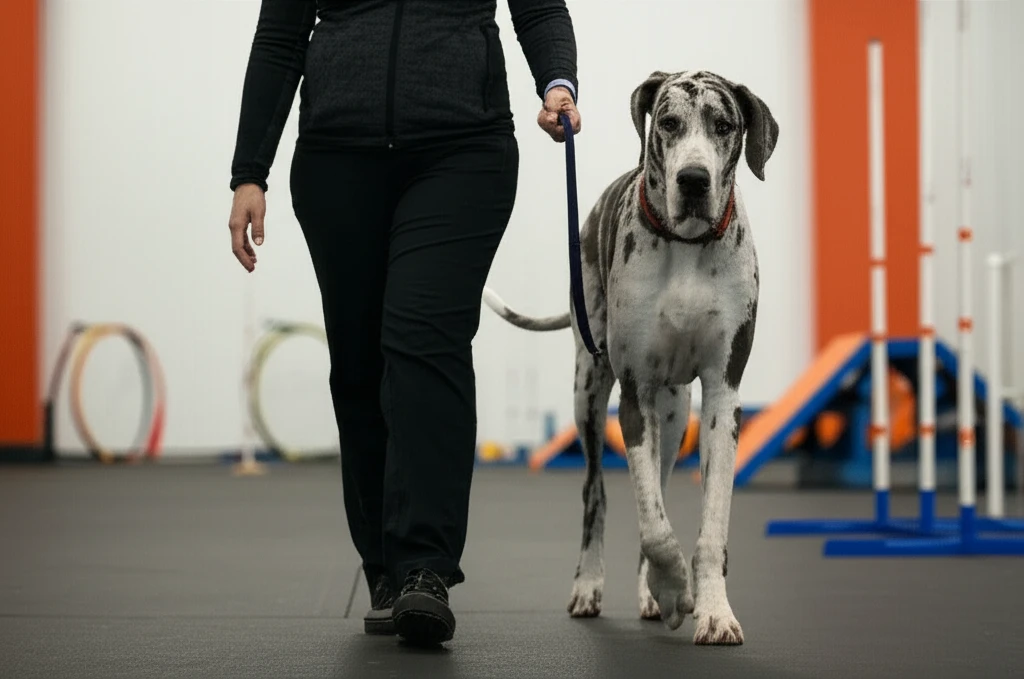
Why Leash Pulling Shows Up Differently in Great Danes
Great Danes do not pull harder than other breeds because they are more stubborn or less trained. They pull harder because of physics. A Great Dane at walking speed generates enough force to pull an average adult off their feet. At a lunge — toward another dog, a squirrel, a person they want to greet — the force is enough to cause falls, dislocated shoulders, broken wrists, and road rash. This is not hypothetical. These injuries happen regularly to Great Dane owners who did not prioritize leash training early enough.
The growth curve is the other factor that makes Great Dane pulling uniquely dangerous. Your puppy goes from 20 pounds to 100 pounds in roughly six months. That means the window between "pulling is manageable" and "pulling is a safety crisis" is extremely short. Most owners of smaller breeds have a year or more to refine leash skills before the dog is strong enough to cause real problems. With a Great Dane, you get weeks. Every walk during that rapid growth phase is either reinforcing good leash habits or building a pulling problem you will not be able to physically manage.
Great Danes also have a long stride and a naturally faster walking pace than most humans. Even a well-mannered Dane will hit the end of a six-foot leash simply by walking at their comfortable speed. This creates constant low-level leash tension that, without training, escalates into full pulling. For the full breakdown of why dogs pull and the core training techniques, see our loose leash walking guide.
What Works for Great Danes Specifically
Standard loose leash training techniques all apply to Great Danes, but equipment choices and timing matter more because of the stakes involved.
A front-clip harness rated for giant breeds is essential. Not optional — essential. The harness must fit properly across your Dane's deep chest without restricting shoulder movement, and the front attachment point must be reinforced enough to handle sudden lunges from a dog this size. Cheap harnesses designed for medium breeds will fail when a Great Dane hits the end of the leash at speed. Invest in equipment built for giant dogs and check the fit regularly as your dog grows, because a Dane puppy can outgrow a harness in a matter of weeks.
Start leash training the day you bring your puppy home. At eight weeks, your Great Dane is small enough that you can easily enforce the stop-and-wait rule: the leash goes tight, you stop; the leash goes loose, you move forward. This is trivially easy with a 15-pound puppy. It is nearly impossible to introduce for the first time with a 120-pound adolescent. The earlier you build this habit, the more it becomes your dog's default behavior before they have the physical power to override it.
Train impulse control separately from walks. Great Danes need a strong foundation in waiting — at doorways, before meals, before greeting people — because their size means that any impulsive lunge carries real consequences. A dog who has practiced impulse control in low-stakes situations will apply that self-regulation to the leash more readily than one who has never learned to wait for anything.
Use your body position strategically. With a giant breed, you cannot rely on arm strength to manage a lunge. Plant your feet, keep the leash short enough to prevent a running start, and position your body at an angle so a sudden pull does not hit you head-on. These are not training techniques — they are safety measures for while you train. The Goldendoodle pulling guide covers leash pulling in a strong but more moderately sized dog, which shows how the same principles scale.
The Socialization Connection
A Great Dane who is well-socialized is a Great Dane who is less likely to lunge. Many pulling incidents are triggered by social excitement or social anxiety — your dog spots another dog or a new person and explodes toward them. A dog who has had extensive, positive exposure to other dogs and people in controlled settings is less likely to treat every encounter as a must-lunge event.
Socialization for Great Danes needs to start early and account for how the dog's size affects other dogs and people. Your Great Dane puppy may be friendly, but a clumsy, enthusiastic 60-pound puppy barreling toward a smaller dog is frightening for that dog and their owner. Structured socialization in an indoor facility teaches your Dane to be around other dogs without charging at them. They learn to coexist calmly rather than treating every dog as a target to reach as fast as possible.
As your Great Dane matures, their sheer presence can trigger reactive behavior in other dogs, which in turn creates leash-pulling situations for you. A well-socialized Dane who reads other dogs' body language and responds calmly — rather than pulling toward or away from a barking dog — is exponentially safer to walk than one who reacts to every reaction.
At Zoom Room, our group training classes give Great Dane owners the controlled environment they need to practice leash skills with real distractions present. Our indoor gyms provide enough space for a giant breed to work, and our trainers understand the specific timing and mechanics that matter when your dog weighs more than you do. Find a Zoom Room near you and start building the leash skills that keep both of you safe.
Frequently Asked Questions
What equipment should I use for a Great Dane who pulls?
A front-clip harness designed for giant breeds is the best starting point. The harness should have a reinforced front attachment point on the chest, fit securely without restricting shoulder movement, and be rated for your dog's weight. Avoid retractable leashes entirely — they teach pulling and offer no control during a lunge. Use a standard six-foot leash made of sturdy nylon or biothane. Never use prong collars, choke chains, or shock collars. These tools suppress pulling through discomfort and can create negative associations with the things your dog sees while wearing them, which is how leash reactivity develops.
My Great Dane puppy is already 80 pounds and pulling hard. Is it too late to fix?
It is not too late, but the urgency is real. An 80-pound Great Dane puppy has several months of rapid growth ahead, and every week that pulling goes unaddressed makes the retraining harder and the safety risk greater. Start immediately with a front-clip harness, the stop-and-wait method on every walk, and high-value rewards for loose leash position. Be prepared for slow walks while the new habit builds. If your dog is pulling hard enough that you cannot safely stop them, work with a trainer who has experience with giant breeds so you get hands-on coaching with your specific dog.
Walk Your Dane Safely
Zoom Room's trainers have experience with giant breeds and understand the specific leash mechanics that keep you and your Great Dane safe. Get started before the next growth spurt.
Find a Zoom Room