
How to Train a Labrador Retriever (Yes, They Can Learn to Calm Down)
Labs are America's most popular breed for a reason -- they're friendly, eager to please, and up for anything. That "up for anything" part is also why you're reading this. A young Lab who hasn't been trained is a 70-pound bundle of joy that knocks over your grandmother, eats things that aren't food, and treats every walk like a sled race.
What Makes Labs Different to Train
The good news: Labs genuinely want to make you happy. They're not stubborn, they're not defiant, and they're not "bad dogs." They're just enthusiastic about everything all the time, and nobody has taught them what to do with all that enthusiasm yet. That's where training comes in -- and Labs, once they understand the game, are some of the fastest learners you'll ever work with.
Every breed brings its own set of tendencies to the training room, and Labs come loaded. Understanding what's hardwired into your Lab -- versus what's just a puppy being a puppy -- will save you a lot of frustration.
- Extremely food-motivated. This is your greatest asset and your biggest headache. Labs are the easiest breed to motivate with treats, which makes positive reinforcement training incredibly effective. It also means they'll counter-surf, steal food off your plate, and eat things that aren't technically food -- socks, remote controls, the occasional wall corner. Guard your sandwiches.
- Mouthy by nature. Labs were bred to retrieve game, so carrying things in their mouth is deeply satisfying to them. Puppy mouthing tends to be more intense with this breed, but it's completely normal behavior. Redirect it -- give them something appropriate to carry -- rather than punishing it. A Lab without something in their mouth is a Lab looking for something to put in their mouth.
- High energy for the first two to three years. "High energy" is an understatement for many young Labs. They need both physical exercise and mental stimulation. One without the other won't cut it. A Lab who gets a long run but no brain work will still find ways to entertain themselves, usually at the expense of your furniture.
- Incredibly social. Labs want to greet every person, every dog, and every interesting squirrel they encounter. This friendliness is wonderful in a trained adult dog. In an untrained adolescent, it looks like lunging, dragging you across the street, and body-slamming strangers with affection. Impulse control becomes the number one training priority.
- People-pleasing but distractible. Your Lab genuinely wants to do the right thing. The challenge is that "the right thing" keeps changing in their mind because they just noticed a bird, a leaf, another dog, a person who might have snacks, and was that a squirrel? They're not ignoring you on purpose. They're just processing a lot of exciting information at once.
- Natural swimmers and retrievers. Use these built-in drives to your advantage in training. Fetch can be a reward. Water activities provide excellent exercise. Scent work taps into their retrieving instincts. Working with the breed's natural tendencies, rather than against them, produces faster results.
The #1 Training Priority: Impulse Control
Here's the thing most Lab owners get wrong: they think they have a behavior problem. They don't. They have an impulse control problem. Your Lab knows they shouldn't jump on guests. They know they shouldn't steal the roast chicken off the counter. They know they should walk nicely on leash. They just can't help themselves in the moment because the impulse to do the fun thing overwhelms the training.
That's why impulse control should be the foundation of every Lab's training, starting from day one. Build these into daily life:
- Wait at every door. Before going outside, before coming inside, before getting out of the car. The door opens when your Lab is sitting calmly, not when they're trying to bulldoze through it. This teaches patience dozens of times a day without any formal training sessions.
- Wait for the food bowl. Set the bowl down. Your Lab sits and waits until you give the release cue. If they break, the bowl goes back up. This sounds simple, but for a food-obsessed breed, it's a genuine exercise in self-control -- and one they'll practice twice a day for their entire life.
- "Leave it" is the most valuable cue for this breed. Teach it early, practice it constantly, and proof it against increasingly tempting distractions. A solid "leave it" can save your Lab from eating something dangerous, prevent them from bolting after a squirrel, and stop counter-surfing before it starts.
- Four-on-the-floor for greetings. No attention of any kind -- no eye contact, no talking, no pushing them down -- until all four paws are on the ground. Every person who interacts with your Lab needs to follow this rule. One grandmother who lets jumping slide because "it's fine, I don't mind" can undo weeks of training.
- Loose-leash walking takes consistent practice. Labs are strong, enthusiastic pullers. The walk doesn't continue when the leash is tight. Period. This means your first few weeks of "walks" might only cover half a block. That's fine. You're building a habit that will last years.
What Actually Works
Labs are remarkably trainable once you understand how they're wired. Here's what produces real results:
- Use their food drive strategically. Train before meals, not after. A Lab who just ate is significantly less motivated than one who's about to eat. Use their regular kibble for basic training and save high-value treats (small pieces of chicken, cheese, or freeze-dried liver) for harder challenges. Measure out their daily food and use a portion of it for training throughout the day.
- Channel the retriever drive. Instead of fighting your Lab's need to carry and fetch things, use it as a training reward. A game of fetch can be more motivating than treats for some Labs. Structured retrieve games, scent work, and hide-and-seek with toys all engage the breed's natural instincts while reinforcing impulse control.
- Keep sessions short and varied. Labs learn fast but get bored with repetition. Five minutes of focused training beats thirty minutes of the same exercise over and over. Mix up the cues, change locations, and end on a success. A bored Lab starts freelancing -- offering random behaviors to see what sticks -- which is entertaining but counterproductive.
- Socialize early and deliberately. Labs are naturally social, but "naturally social" without proper exposure turns into excitement-based reactivity. A Lab who loses their mind every time they see another dog hasn't been socialized -- they've just been excited. True socialization means learning to be calm around other dogs, other people, and new environments. Group classes are ideal for this because they provide controlled exposure with guidance.
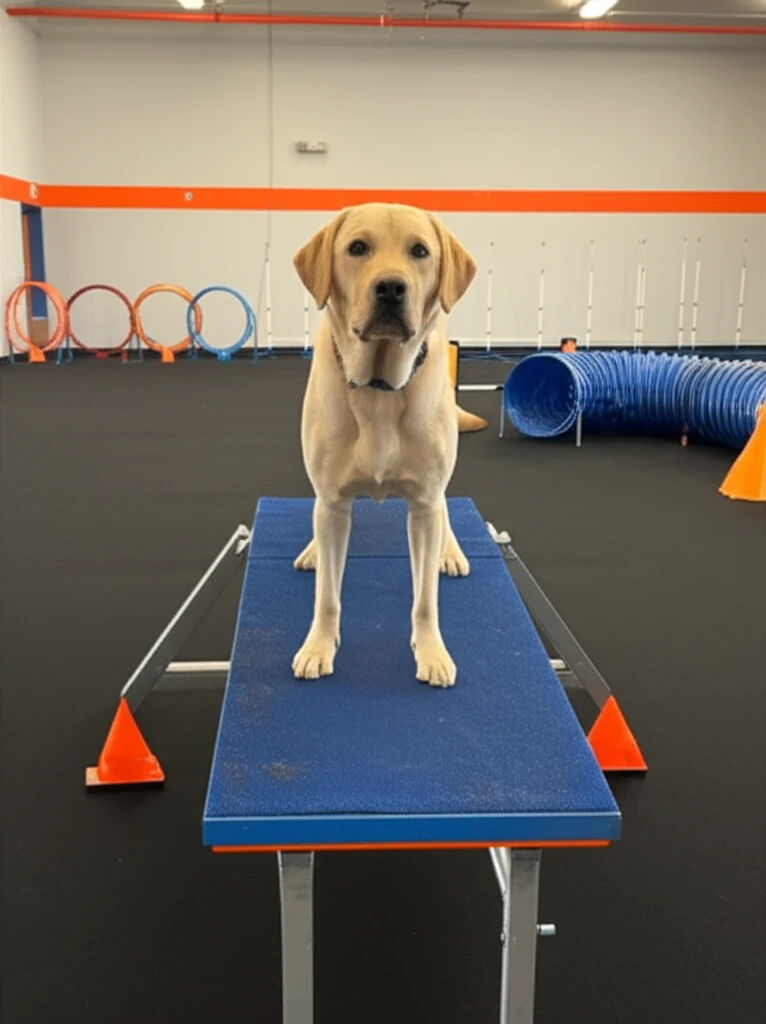
- Try agility. Agility is phenomenal for Labs. It combines physical exercise, mental problem-solving, and impulse control into one activity. Your Lab has to listen to you, think about what they're doing, and control their body -- all while running and jumping, which they already love. It's the training equivalent of a job they were born to do.
Common Mistakes Lab Owners Make
Even experienced dog people fall into these traps with Labs, because Labs make the mistakes look so charming:
- Trying to out-exercise them. You cannot tire out a young Lab with physical exercise alone. You'll get a fit, muscular Lab who still eats your couch. Running, swimming, and hiking are great, but you need to pair physical activity with mental work -- puzzle toys, training sessions, scent games, frozen Kongs. A tired brain is worth more than tired legs.
- Letting jumping slide "because they're friendly." Yes, your Lab is jumping because they love people. That's sweet. It's also 70 pounds of momentum hitting someone in the chest. When your Lab is a puppy, jumping seems harmless. When they're full-grown and greeting a child or an elderly person, it's a safety issue. Train four-on-the-floor from the start, before it's a problem.
- Free-feeding. Leaving food out all day removes your single most powerful training tool. Labs who can eat whenever they want are less motivated by treats during training. Scheduled meals give you leverage, help you monitor how much your Lab eats (important for a breed prone to obesity), and make food-bowl impulse control exercises possible.
- Not starting impulse control early enough. A 15-pound Lab puppy jumping on you is cute. A 70-pound adult Lab doing the same thing is a problem. A puppy stealing a sock is funny. An adult Lab swallowing a sock is an emergency vet visit. Every behavior that's "adorable" in a puppy needs to be evaluated at full adult size and strength. Start the rules now.
The Bigger Picture
A well-trained Labrador Retriever is one of the most versatile, enjoyable dogs on the planet. They can hike with you all day, lie quietly at your feet during dinner, greet your friends without bowling them over, and adapt to just about any lifestyle you throw at them. That's the dog you're building toward.
The investment in impulse control and socialization during the first two years pays off for the next ten-plus. Labs who learn self-control as youngsters become the calm, reliable adults that make the breed so beloved. They're the dogs you can take anywhere -- restaurants, offices, road trips, family gatherings -- because they know how to regulate their own excitement.
Group training classes are the ideal environment for Lab training because they combine everything this breed needs: structured learning, socialization with other dogs and people, impulse control practice in a distracting environment, and the mental stimulation of learning new skills. Your Lab gets to be around other dogs -- their favorite thing -- while practicing calm behavior, which is exactly the skill most Labs need most.
Frequently Asked Questions
When do Labrador Retrievers calm down?
Most Labs begin to settle between two and four years old, but this timeline depends heavily on training and mental stimulation. A Lab who receives consistent impulse control training, daily mental enrichment, and structured exercise will mature into a calm adult much sooner than one who is simply exercised physically. The key is pairing physical outlets with brain work -- puzzle toys, training sessions, and scent games. Waiting for a Lab to outgrow their energy without training is not a reliable strategy.
How do I stop my Lab from eating everything?
Labs are hardwired to put things in their mouths -- they were bred to retrieve, and that oral fixation extends to socks, shoes, and anything left within reach. The most important cue to teach is a strong "leave it," practiced with increasingly tempting items. Manage the environment by keeping counters clear and valuables out of reach. Redirect the mouthing instinct toward appropriate items like chew toys and Kongs. Scheduled meals instead of free-feeding also help, because a Lab on a feeding routine is more responsive to food-based training cues.
Are Labs good family dogs for homes with young children?
Labs are one of the best family breeds when properly trained. Their gentle temperament, patience, and love of people make them wonderful companions for children. The key is investing in impulse control training early so your Lab learns to greet kids calmly rather than bowling them over with enthusiasm. Teach children how to interact respectfully with the dog, and supervise interactions until both the dog and the children understand the boundaries. A Lab who has been through structured training and socialization is a steady, reliable family member.
Channel That Lab Energy
Group classes give your Lab the socialization, structure, and impulse control practice they need -- all in one place.
Find a Zoom Room