
How to Train a Pit Bull
Pit bulls are strong, enthusiastic, deeply people-oriented dogs who are held to a higher standard than any other breed. Every interaction is watched, every mistake is amplified, and the margin for error is thinner. Training your pit bull well isn't just good ownership. It's advocacy.
The Stigma Problem (And Why Training Is the Answer)
Pit bulls carry more breed-based stigma than any other type of dog. Breed-specific legislation restricts or bans them in some areas. Insurance companies flag them. Landlords exclude them. And the perception that pit bulls are inherently dangerous persists despite the fact that both the American Veterinary Medical Association and the American Veterinary Society of Animal Behavior have stated that breed is a poor predictor of individual behavior.
The science is clear. Aggression is influenced by genetics, socialization, training, and individual history — not by breed label alone. Studies examining dog bite data consistently find that visual breed identification is unreliable and that factors like socialization history, owner behavior, and reproductive status are far more predictive than breed.
None of that changes your pit bull's reality. Your dog will be judged more harshly than a Golden Retriever who does the same thing. A pit bull who jumps up to greet someone gets called aggressive. A pit bull who barks on leash gets called dangerous. Fair or not, that's the environment, and the most powerful tool you have against it is a well-trained, well-socialized dog whose behavior speaks louder than the stereotype.
Every positive interaction your pit bull has with a neighbor or a child on the sidewalk challenges the narrative. Training isn't just about your dog's quality of life — it's about changing minds, one calm interaction at a time.
Socialization: Building Your Dog's Resume
Socialization is important for every breed. For pit bulls, it's a strategic imperative. A well-socialized pit bull who moves through the world with calm confidence is the single most effective argument against breed-specific legislation. Every positive encounter is evidence that contradicts the stereotype.
Start socialization early and make it comprehensive. Your pit bull needs positive exposure to people of all ages, sizes, and appearances. They need to meet other dogs in controlled, positive contexts — not the chaotic dog park, but structured settings where interactions are supervised and success is likely.
Pit bulls are naturally people-oriented — most don't need to be taught to love humans. Your job is to teach them how to express that enthusiasm in socially acceptable ways. A pit bull who launches themselves at every person because they're thrilled to say hello can easily be perceived as a threat by someone who doesn't know the breed.
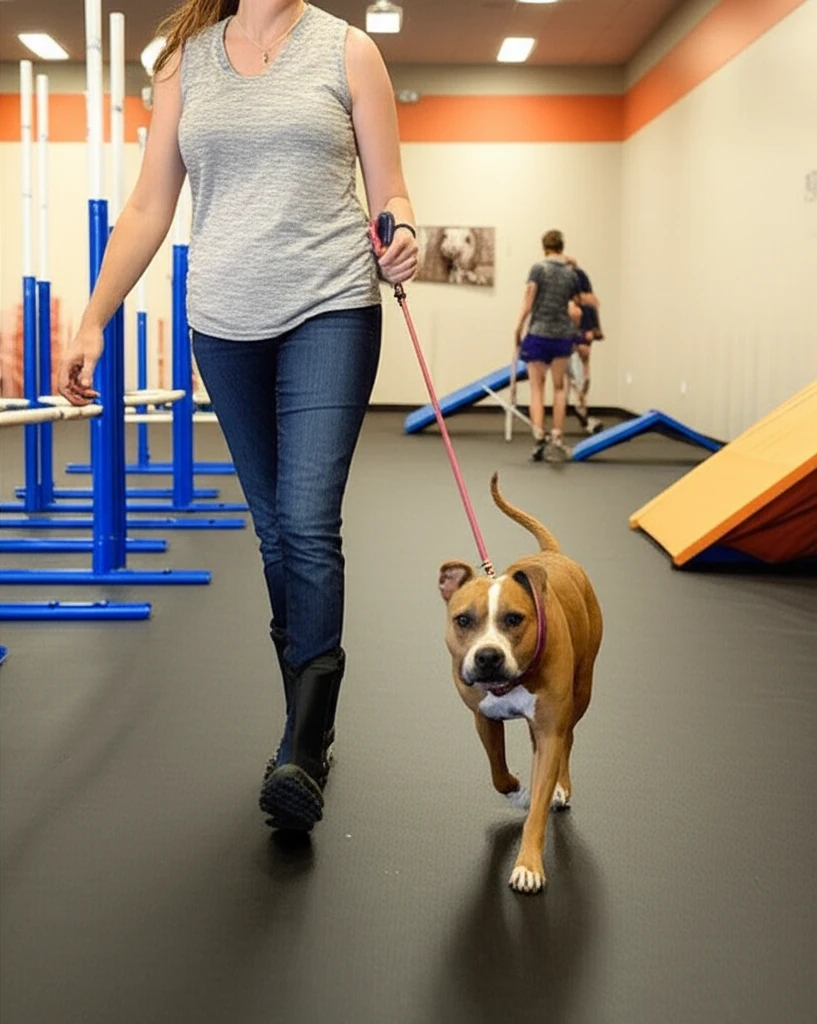
Structured socialization programs in controlled indoor environments are ideal for pit bulls. The setting is predictable, the interactions are managed, and your dog gets to practice meeting new dogs and people with professional guidance. That consistent, positive exposure builds the track record your pit bull needs.
Leash Reactivity: It's Usually Frustration, Not Aggression
If your pit bull barks, lunges, or pulls frantically toward other dogs on leash, your first instinct might be to worry about aggression. In pit bulls, leash reactivity is more often frustration-based than fear-based. Your dog isn't trying to attack. They're trying desperately to get to the other dog because they want to play or greet — and the leash is preventing it.
Frustration-based reactivity looks intense. The barking is loud, the pulling is powerful, and to an onlooker it's indistinguishable from aggression. A frustrated pit bull on leash looks, to someone unfamiliar with the breed, like an aggressive pit bull. That perception leads to complaints, restrictions, or worse.
The fix is teaching your pit bull that seeing other dogs predicts good things from you. When another dog appears at a distance, mark the moment your pit bull notices and reward attention to you. Build the pattern: other dog, check in, reward. Over time, the sight of another dog becomes a cue to look at you. This is a well-established protocol across breeds, but it's especially important for pit bulls because of the stakes.
Use a front-clip harness for better steering. Practice at distances where your pit bull can see other dogs without losing composure. And stay calm — your tension travels down the leash, and pit bulls are sensitive to their owner's emotional state.
Strength and Impulse Control
Pit bulls are strong. Not just for their size — genuinely, pound-for-pound strong. A fifty-pound pit bull who hasn't learned impulse control can knock over an adult, drag you down the street, or bowl over a child during enthusiastic play. None of that is aggression. It's unmanaged strength combined with exuberant enthusiasm.
Impulse control training teaches your pit bull to pause before acting on excitement. Wait at doors instead of blasting through. Sit before meals. Hold a stay while you prepare a walk. These are life skills that prevent your pit bull's strength from creating situations that get misinterpreted.
One important note: pit bulls have a high pain tolerance and a stoic disposition that can make their stress signals subtle. Where another breed might yelp or cower, a pit bull may simply stiffen, freeze, or go quiet. Learning to read the early, quiet signals — a closed mouth, a hard eye, a subtle weight shift — is critical. If your pit bull seems fine right up until the moment they're not, you're likely missing the earlier signals. A professional trainer can help you learn to read your specific dog.
Structured play is essential. Tug is an excellent game for pit bulls — it channels their strength into a rule-based activity with a clear start and stop. Your dog drops the toy on cue, waits for an invitation to grab again, and the game ends calmly. This teaches your pit bull that intensity has boundaries.
The Pit Bull Your Neighborhood Needs to Meet
Well-socialized, well-trained pit bulls are among the best family dogs you can own. They're loyal without being clingy, playful without being destructive, and genuinely attuned to the emotional needs of their household. The breed's history as a family companion — before media distortion reshaped public perception — is demonstrated by well-trained pit bulls every day.
Your pit bull can excel in obedience, agility, nose work, trick training, and therapy work. The breed's eagerness to work with their handler makes training sessions productive and rewarding for both of you.
Part of owning a pit bull responsibly means being an ambassador. Keep your dog well-groomed and on a proper harness. Practice polite leash manners in public. Let people approach on their terms. Every positive public interaction moves the needle.
At Zoom Room, our socialization and training programs welcome every breed, and pit bulls are among our most successful students. The structured, indoor environment gives your pit bull consistent, positive training experiences that build the skills and social confidence they need. Find a Zoom Room near you and give your pit bull the training that changes perceptions — starting with your own neighborhood.
Frequently Asked Questions
Are pit bulls aggressive by nature?
No. Both the American Veterinary Medical Association and the American Veterinary Society of Animal Behavior have stated that breed is a poor predictor of individual behavior. Aggression in any dog is influenced by genetics, socialization, training, individual history, and context — not by breed label. Studies consistently show that visual breed identification is unreliable and that factors like socialization history and owner behavior are far more predictive of behavior than breed. Well-socialized, well-trained pit bulls are loyal, people-oriented companions. The stigma reflects public perception, not scientific evidence.
Why does my pit bull go crazy when they see other dogs on leash?
In most pit bulls, leash reactivity is frustration-based, not aggression-based. Your dog wants to get to the other dog to greet or play, and the leash is preventing it. That frustration explodes outward as barking and lunging, which looks alarming but is actually your dog saying "I want to go say hi and I can't." The fix is a structured look-at-me protocol: when your dog sees another dog, reward them for checking in with you instead of pulling toward the other dog. Over time, the sight of another dog becomes a cue to look at you. Use a front-clip harness for better management and work at distances where your dog can stay under threshold.
How do I socialize my pit bull safely given the breed stigma?
Structured, indoor socialization programs are your best option. They provide controlled environments where interactions are supervised and your dog can build positive experiences without the unpredictability of dog parks or sidewalk encounters. Keep your dog on a properly fitted harness in public, practice polite leash manners, and let interactions happen on other people's terms. Never force greetings. When someone wants to meet your dog, ask your pit bull to sit first — a calm, seated pit bull with a relaxed body changes perceptions faster than anything you could say. Every positive encounter is advocacy for the breed.
Ready to Get Started?
Zoom Room welcomes every breed and celebrates the pit bulls who train with us. Our structured, indoor programs build the skills and social confidence your dog needs — and the positive reputation the breed deserves. Find a location near you.
Find a Zoom Room