
How to Train a Poodle (They're Already Training You)
Poodles--whether Standard, Miniature, or Toy--are consistently ranked among the most intelligent dog breeds. This means they pick up cues in a fraction of the repetitions other breeds need. It also means they pick up patterns you didn't know you were creating, figure out how to open things you thought were secure, and will absolutely learn to manipulate the household routine to their advantage. Training a Poodle isn't about whether they can learn. It's about staying one step ahead.
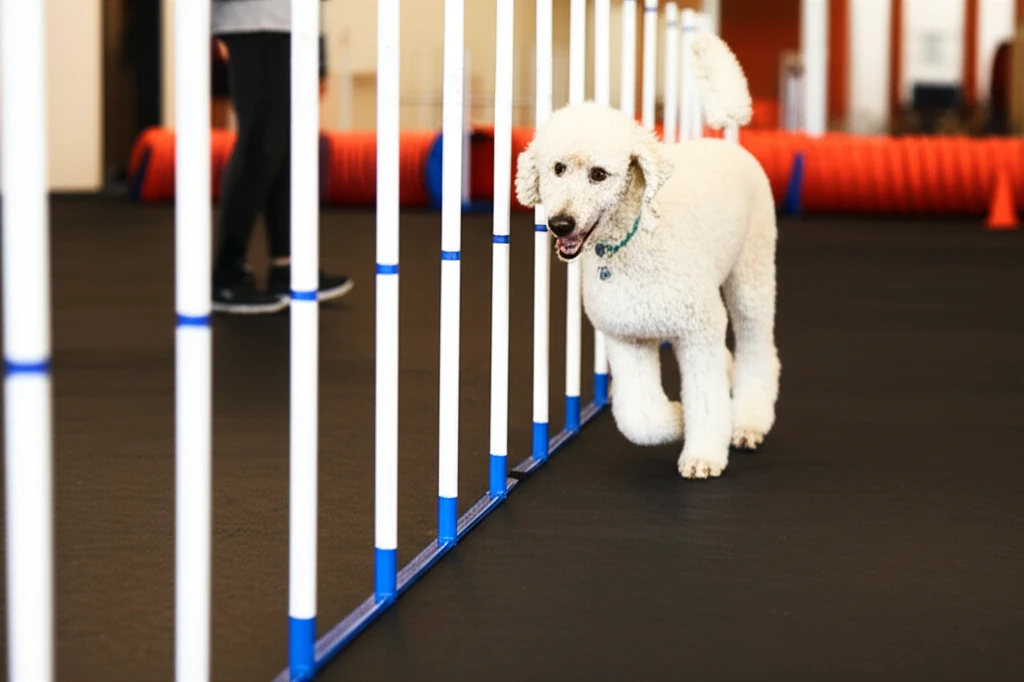
What Makes Poodles Different to Train
Poodles are fast learners. Dangerously fast. They'll pick up a new cue in a handful of repetitions--and then get bored of repeating it. Repetitive drills kill their motivation faster than almost any other breed. If you run the same sit-down-sit-down sequence ten times, they'll start offering alternative behaviors just to see what happens. That's not disobedience. That's a dog looking for a more interesting problem to solve.
All three sizes--Standard, Miniature, and Toy--share the same cognitive wiring. This is where owners of smaller Poodles make their biggest mistake: treating a Toy Poodle like a lap ornament rather than a working brain that happens to weigh seven pounds. Every Poodle, regardless of size, needs mental work. Skip it and you'll find out what a bored genius with teeth does to your furniture.
They're also remarkably sensitive to tone and body language. A Poodle reads your posture, your breathing, your hesitation. If you're frustrated, they know it before you've said a word--and most will shut down rather than push through. Harsh corrections don't toughen a Poodle up. They make the dog anxious, avoidant, or both. Positive reinforcement isn't just the ethical choice with this breed--it's the only approach that consistently produces results.
Without adequate socialization, Poodles can become reserved or aloof with strangers. This is especially common in Toy and Miniature Poodles whose owners carry them through the world rather than letting them walk through it. A Poodle who never touches the ground in public never learns to navigate it confidently. Put them down.
The Intelligence Factor
Here's the thing about training a highly intelligent dog: they learn patterns, not just cues. If you always reach for the treat bag before giving a cue, your Poodle will learn that the treat bag is part of the cue--and refuse to work when it's not visible. If you always train in the kitchen, they'll perform flawlessly by the refrigerator and stare blankly at you in the park. They're not being stubborn. They learned exactly what you taught them, which was more specific than you realized.
The solution is deliberate variation. Change the room. Change the reward. Change the order. Use treats sometimes, a toy sometimes, praise sometimes. Train before meals and after walks. If your Poodle can't predict what's coming next, they have to actually pay attention to what you're asking--and that's when real learning happens.
Channel the intelligence into structured problem-solving. Puzzle toys, scent work, trick chains, urban herding--anything that requires thinking, not just compliance. A Poodle who spends ten minutes working a puzzle feeder is getting more mental exercise than one who runs laps in the yard for an hour.
A bored Poodle is a destructive Poodle. They don't chew your shoes because they're bad dogs. They do it because they have a brain that needs a job and you didn't give them one. Mental stimulation is daily maintenance for this breed, not an occasional luxury.
Size-Specific Considerations
Standard Poodles are athletes. They were originally bred as water retrievers, and they've retained that physical drive. They need real exercise--not just a walk around the block, but running, swimming, or sustained activity. They excel at agility, and many Standards are natural jumpers. If your yard has a four-foot fence, consider it a suggestion. Pair physical outlets with mental work: a tired body with an active mind is still a restless dog.
Miniature Poodles are the Goldilocks of the breed--active enough for dog sports, compact enough for apartment life, sturdy enough to handle rougher play. They're arguably the most versatile size for training, and they take to group classes particularly well. Don't let the convenient size fool you into thinking they need less training. They don't.
Toy Poodles are the most under-trained variety because people assume a five-pound dog doesn't need obedience work. This is how "small dog syndrome" happens--and to be clear, small dog syndrome is a training failure, not a breed trait. A Toy Poodle who growls at strangers, snaps when picked up, or barks incessantly wasn't born that way. They were simply never taught otherwise because someone thought it was cute or harmless when the dog was small enough to hold in one hand. It wasn't.
What Actually Works
Variety in training. New tricks, new environments, new challenges. Poodles thrive when sessions feel fresh. Rotate through different skills rather than drilling one to perfection. Once they understand a behavior, move on and circle back later. The review will stick better than the repetition.
Trick training. Poodles excel here, and it's not just party tricks. Teaching a sequence of behaviors--spin, bow, back up, weave through legs--requires concentration, body awareness, and impulse control. It's mentally taxing in exactly the right way for this breed. Clicker training makes the precision work even sharper.
Scent work. This is one of the best outlets for Poodle intelligence. Searching for hidden odors engages their brain at full capacity in a focused, calm way. It's also one of the few activities where the dog leads and the handler follows, which Poodles quietly appreciate.
Consistent rules. Poodles will find every loophole in your household rules and drive a truck through them. If the couch is off-limits except when you're tired, the Poodle has learned the couch is allowed--just not immediately. Be consistent. They're paying closer attention than you think.
Early socialization. Expose puppies to different people, environments, surfaces, and sounds from the start. A well-socialized Poodle is confident and adaptable. One who missed that window tends toward nervousness or standoffish behavior that's much harder to address later.
The Bigger Picture
A well-trained Poodle is one of the most rewarding dogs you'll ever live with. They're adaptable, responsive, genuinely funny, and capable of learning nearly anything you're willing to teach. The hypoallergenic coat makes them one of the most popular breeds in the country--but popularity doesn't mean they're easy. They deserve training worthy of their intelligence, not a pass because they're cute.
Socialization prevents the nervousness and aloofness that people sometimes mistake for breed temperament. A Poodle who meets the world on their own four feet grows into a dog who handles new situations with curiosity instead of anxiety.
Group classes are particularly well-suited to Poodles. They combine the variety, social exposure, and structured challenges this breed needs--all in one session. The novelty of a classroom environment, other dogs, and rotating exercises keeps a Poodle's brain engaged in a way that solo training at home can't replicate.
The bottom line: your Poodle is watching, learning, and forming opinions about everything you do. Make sure the lessons are intentional.
Frequently Asked Questions
Do Standard, Miniature, and Toy Poodles all need the same amount of training?
Yes. All three sizes share the same intelligence and need the same quality and consistency of training. The biggest mistake owners of smaller Poodles make is assuming a Toy or Miniature doesn't need obedience work because of their size. Every Poodle, from a 60-pound Standard to a 5-pound Toy, needs mental stimulation, socialization, consistent rules, and positive reinforcement training. Skipping training for smaller Poodles is how unwanted behaviors like excessive barking, snapping, and nervousness develop.
Why does my Poodle get bored during training sessions?
Poodles learn so quickly that repetitive drills lose their appeal fast. If you're running the same cue over and over, your Poodle has already mastered it and is looking for a new challenge. The fix is variety: rotate through different skills within a single session, change locations regularly, and mix up your rewards between treats, toys, and praise. Trick training and scent work are especially good for Poodles because they present novel problems to solve. Keep sessions short, end on a success, and your Poodle will stay eager to train.
How do I socialize a Toy or Miniature Poodle who seems nervous around strangers?
Start by letting your Poodle walk on their own feet in new environments rather than carrying them. A dog who is always carried never builds confidence navigating the world independently. Introduce new people at your dog's pace -- let strangers offer a treat without reaching toward the dog, and reward any calm or curious behavior. Avoid flooding your Poodle with too much too fast. Structured group classes provide controlled, positive social exposure that builds confidence gradually. Consistency is key: regular positive encounters with new people and settings prevent nervousness from becoming a fixed pattern.
Give Them the Challenge They Deserve
Group classes bring the variety, socialization, and mental stimulation that Poodles need to thrive.
Find a Zoom Room