
Rottweiler Reactivity: How to Help Your Rottie Around Other Dogs
Your Rottweiler spots another dog on a walk and transforms. The barking, the lunging, the stiff-bodied intensity — and you are on the other end of a leash attached to 100 pounds of determination. Reactivity in a Rottweiler is not a lost cause, but it does require a plan that accounts for the breed's specific temperament and strength.
Why Reactivity Shows Up Differently in Rottweilers
Rottweilers were bred to be watchful. They are a guardian breed with strong territorial instincts, a natural wariness of unfamiliar dogs, and a physical presence that makes every reaction look more intense than it might be in a smaller breed. When a Rottweiler barks and lunges on leash, the other dog's owner is frightened. The other dog is frightened. And the situation escalates in a way that does not happen when a Beagle does the same thing.
This is the core challenge with Rottweiler reactivity: the margin for error is smaller. Not because Rottweilers are inherently dangerous, but because their size and strength mean that a reactive outburst has more physical consequences. A reactive Rottweiler can pull a handler off their feet. A reactive Rottweiler who gets loose can do real damage, even if the intent was only to investigate. The behavior itself may not be worse than any other reactive dog, but the stakes are higher.
Rottweiler reactivity is most often rooted in one of two things: undersocialization during the critical period (before 16 weeks) or learned behavior on leash. Many Rottweilers are calm and confident off leash but become reactive when restrained because the leash removes their ability to choose distance. This is called leash frustration, and it is one of the most common forms of reactivity in this breed. For a full breakdown of leash reactivity causes and training, see our dedicated guide.
What Works for Rottweilers Specifically
Manage first, train second. Before you can change the behavior, you need to prevent rehearsal. Every time your Rottweiler lunges at another dog and you get dragged away, the pattern gets stronger. Use a front-clip harness to reduce pulling leverage. Walk during off-peak hours when you can control the distance to other dogs. Cross the street before your dog goes over threshold. You are not avoiding the problem. You are creating the conditions where training can actually work.
Build a strong attention cue. Rottweilers are focused dogs who bond tightly with their handler. Use that. Train a "watch me" or "look" cue at home until your dog can hold eye contact for five seconds without distractions. Then practice in the yard, then on quiet walks. When you can reliably get your Rottweiler's attention in low-distraction environments, you have a tool to redirect them before they fixate on another dog.
Counter-condition the trigger. When your Rottweiler notices another dog at a distance where they are alert but not yet reactive, mark that moment and feed a high-value treat. You are changing the emotional response: "other dog appears" starts to predict "something good happens" instead of triggering a defensive reaction. The distance is critical. If your Rottweiler is already barking, you are too close. Start far enough away that your dog can notice the other dog and still take food. Gradually decrease the distance over weeks, not days.
German Shepherds share a similar guardian-breed reactivity profile — our German Shepherd reactivity guide covers the nuances specific to that breed. For a comprehensive look at dog-to-dog reactivity across all breeds, see our dog reactivity and aggression guide.
The Socialization Connection
Rottweiler reactivity is often preventable with early, structured socialization, but if your dog is already reactive, socialization is still part of the solution. It just looks different than it does with a puppy.
For an adult reactive Rottweiler, socialization does not mean throwing your dog into a dog park and hoping for the best. That would be flooding, and it typically makes reactivity worse. Instead, you need controlled, gradual exposure. Start with parallel walks: you and your Rottweiler walk alongside another calm dog at a comfortable distance, with no direct interaction. Over time, decrease the distance as your dog demonstrates calm behavior. This teaches your Rottweiler that other dogs can exist nearby without being a threat.
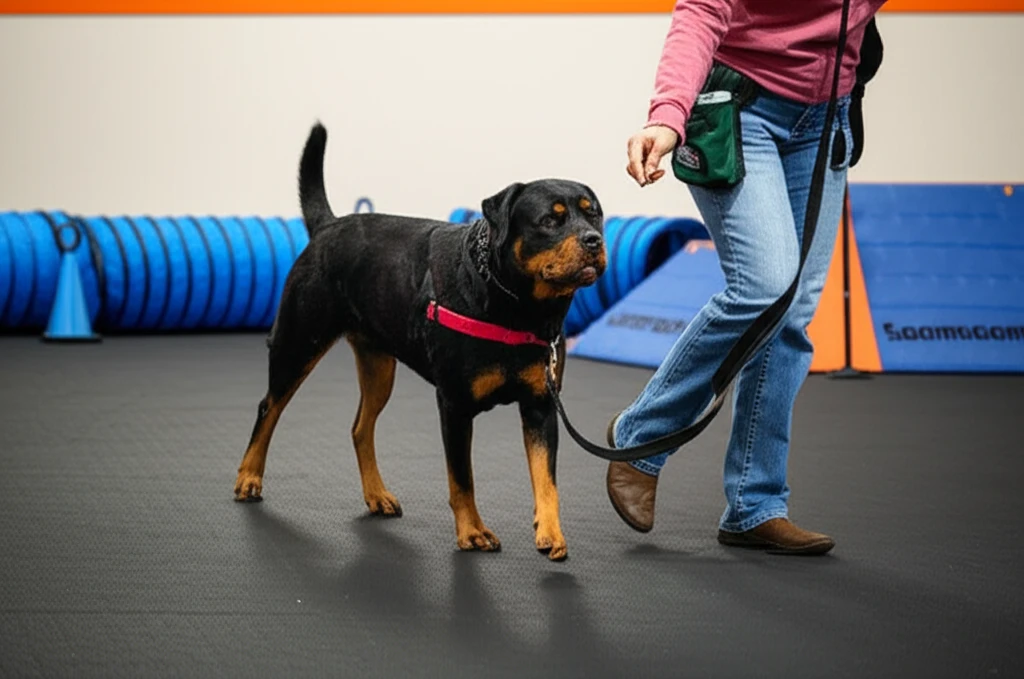
Structured group classes are valuable precisely because the environment is managed. Dogs are at controlled distances, the space is enclosed so there is no worry about loose dogs approaching unexpectedly, and a trainer is present to read body language and adjust the plan. Your Rottweiler learns to be around other dogs in a predictable setting where they can build confidence without being overwhelmed.
The goal is not to make your Rottweiler love every dog they meet. Some Rottweilers will always prefer to keep their distance from unfamiliar dogs, and that is perfectly fine. The goal is neutral tolerance: your Rottweiler can walk past another dog without reacting, and you can relax your grip on the leash. For our full guide to the Rottweiler training approach, start there for broader context.
Find your nearest Zoom Room to work on reactivity in a controlled indoor environment with professional guidance.
Frequently Asked Questions
Is my Rottweiler aggressive or just reactive?
Reactivity is an outsized emotional response to a trigger, usually driven by fear, frustration, or overstimulation. Aggression involves intent to harm. Most reactive Rottweilers are not aggressive. They are anxious or frustrated dogs who have learned that barking and lunging makes the scary thing go away. A professional trainer can assess your dog's body language to determine the motivation behind the behavior and build an appropriate training plan.
Should I use a prong collar or e-collar for my reactive Rottweiler?
No. Aversive tools like prong collars and e-collars add pain or discomfort to a situation where your dog is already stressed. This can suppress the visible signs of reactivity while increasing the internal anxiety, which often leads to a sudden escalation later. Worse, your dog can associate the pain with the other dog, making the reactivity worse over time. Positive reinforcement-based counter-conditioning is more effective and does not carry these risks.
Ready to Work on Reactivity?
Zoom Room's indoor training environment is designed for exactly this: controlled distances, managed distractions, and professional trainers who can help your Rottweiler build confidence around other dogs at a pace that works for them.
Find a Zoom Room