
How to Train a St. Bernard
Your St. Bernard puppy is going to weigh somewhere between 120 and 180 pounds as an adult. Every cute behavior you let slide right now, the jumping, the pulling, the leaning on guests, becomes a serious problem when your dog outweighs most of the humans in your household. The training window is open. It will not stay open long.
Manners First, Everything Else Second
St. Bernards grow fast and they grow big. A puppy who gains ten to fifteen pounds per month during the first year does not give you the luxury of waiting to address unwanted behaviors. A ten-week-old Saint leaning against your leg is endearing. A 160-pound adult doing the same thing can knock a child off their feet. A puppy mouthing your hand is a normal developmental phase. An adolescent Saint mouthing with that same jaw is a problem that needs to have been solved months ago.
Start with the behaviors that matter most for a giant breed: four feet on the floor for greetings, loose leash walking, settling calmly in the house, and gentle mouth handling. These are not advanced skills. They are survival skills for living with a dog this size. Teach a default sit for every greeting from the first day your puppy comes home. Every person who interacts with your Saint should follow the same protocol: ignore jumping, reward sitting. No exceptions. The inconsistency that a small breed can get away with becomes unmanageable in a giant breed.
Impulse control deserves special emphasis with St. Bernards. Wait at doorways. Sit before meals. Stay with increasing duration. A giant breed who has learned to pause before acting is a dog you can live with safely. A giant breed who acts on every impulse is a dog who runs the household by sheer physical force, and that is not a situation anyone, including the dog, benefits from.
Gentle but Strong: The Leash Challenge
Walking a St. Bernard who pulls on the leash is not an annoyance. It is a physical hazard. The force generated by a 150-plus-pound dog moving with purpose can injure wrists, shoulders, and backs. People get pulled off their feet. Leashes get dropped. And a loose St. Bernard in traffic is a crisis that nobody wants to manage.
Leash training needs to start the week your Saint puppy comes home and continue with absolute consistency through adolescence. Use a front-clip harness from the beginning. It redirects forward momentum into a turn, mechanically reducing pulling without discomfort. A flat collar on a pulling Saint puts enormous pressure on the trachea and gives you zero mechanical advantage.
The training approach is straightforward: reward your dog for walking at your side, stop moving the instant the leash goes tight, and change direction frequently to keep your Saint engaged with where you are going. The difference with a giant breed is that you cannot afford to be inconsistent. Every walk where pulling works, where your Saint drags you to a fire hydrant or a passing dog and succeeds, reinforces the pulling behavior. With a small dog, that is a slow-building problem. With a Saint, it is a fast-building safety issue. Put in the daily work now, and you will have a dog you can walk for the next eight to ten years without needing a chiropractor.
Slow to Mature: Patience Is Part of the Job
St. Bernards are slow to mature, both physically and mentally. Your Saint may not reach full adult size until age two or three, and their brain often lags behind their body by a significant margin. This means you will spend months living with a dog who has the body of a giant and the impulse control of a puppy. That gap between physical capability and mental maturity is where most giant breed training challenges live.
Understanding this timeline helps set expectations. Your 18-month-old Saint who still gets the zoomies, who occasionally forgets their leash manners, who sometimes acts like they have never heard the word sit before, is not being defiant. They are still developing. The same cue that a mature Saint will respond to reliably may get an inconsistent response from an adolescent whose brain is not finished growing yet.
The answer is patience paired with consistency. Keep training through the awkward adolescent phase even when progress feels slow. Keep the rules the same even when your puppy is acting like they forgot everything you taught them last week. Giant breeds who are trained steadily through adolescence emerge as some of the most reliable, well-mannered dogs you will encounter. Giant breeds whose owners gave up during adolescence become the dogs who are surrendered to rescue at two years old. Stay the course. It pays off.
Socialization and Heat: Two Things You Cannot Ignore
St. Bernards are generally gentle, tolerant dogs, and that reputation sometimes leads owners to skip socialization on the assumption that their Saint will be fine with everything. Do not make that assumption. A St. Bernard who has not been properly socialized can become fearful of unfamiliar situations, and a fearful dog who weighs 160 pounds presents challenges that a fearful Chihuahua does not.
Socialize your Saint puppy early and broadly. Different people, different dogs, different environments, different surfaces and sounds. Let them observe new situations from a comfortable distance before approaching. Reward calm, curious behavior. The socialization window closes around 16 weeks, and what you accomplish during that period sets the foundation for your Saint's behavior around new experiences for the rest of their life.
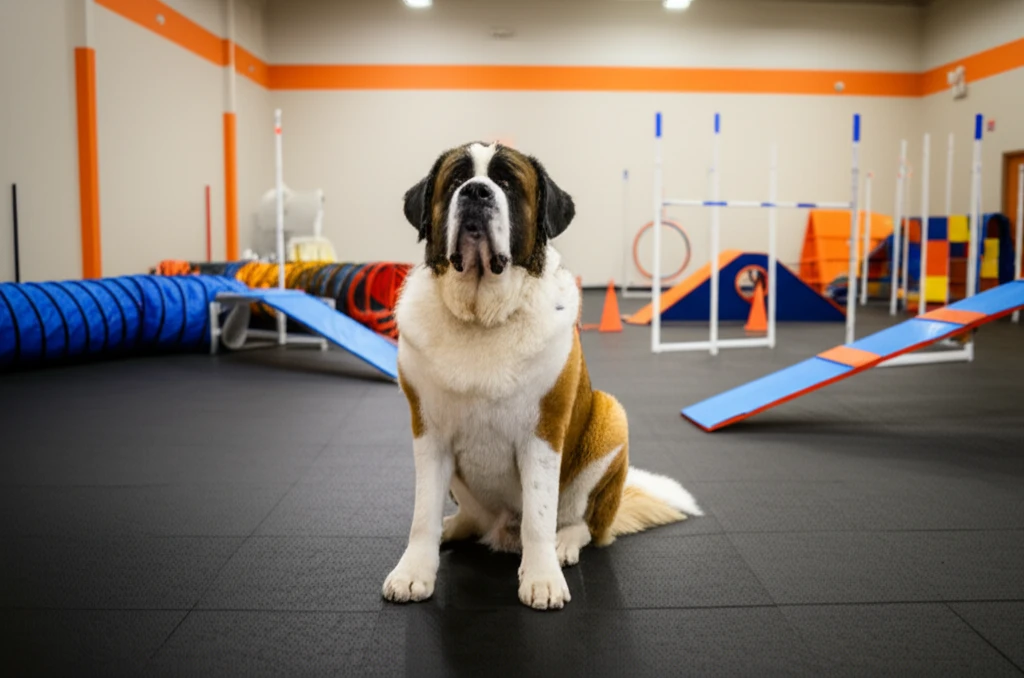
Heat sensitivity is a practical training consideration that many Saint owners underestimate. St. Bernards are built for cold climates, with a heavy coat and a large body mass that retains heat. Training outdoors in warm weather is not just uncomfortable for your Saint. It is potentially dangerous. A dog who is overheating cannot learn, cannot focus, and is at risk for heat stroke. Schedule outdoor training for the coolest parts of the day, keep sessions short during warm months, and always have water available. An indoor, climate-controlled training facility eliminates the weather variable entirely and lets your Saint train at full capacity regardless of the season.
Building a Life With a Giant Breed
A well-trained St. Bernard is one of the most pleasant dogs to share a home with. They are calm, devoted, patient with children, and content to be wherever their family is. That easy-going temperament is real, but it does not happen by accident. It is the result of early training, consistent rules, proper socialization, and an owner who took the time to teach manners while the dog was still small enough to manage.
Daily life with a Saint requires some practical adjustments. Plan for drool. Keep towels in every room and in your car. Protect furniture and clothing that you care about, because a head shake after a drink can redecorate a wall. Practice body handling early and often, because a 160-pound dog who panics at the veterinarian is a logistical nightmare. Crate training with an appropriately sized crate gives your Saint a space of their own and helps with house training during puppyhood, though you will graduate to a dog bed or designated space as they reach full size.
St. Bernards do not need intense physical exercise, but they do need daily movement and mental stimulation. Short walks, training sessions, and enrichment activities keep their brain and body engaged without stressing growing joints. Avoid high-impact exercise, jumping, and extended stair climbing until your veterinarian confirms the growth plates have closed. Find a Zoom Room near you and start building the foundation your Saint needs while the training window is still wide open.
Frequently Asked Questions
Are St. Bernards easy to train?
St. Bernards are willing and generally eager to please, which makes them receptive to training. The challenge is not intelligence or temperament but timing and physical size. Because they grow so quickly, you have a narrow window to establish good manners before your dog's size makes unwanted behaviors difficult or dangerous to manage. They also mature slowly, so expect puppyish behavior well past a year old. Start early, be patient through adolescence, and stay consistent with the rules. A St. Bernard who understands the expectations is a remarkably well-mannered dog.
How much exercise does a St. Bernard need?
St. Bernards need moderate daily exercise. A couple of walks plus some play or training time is usually sufficient. They are not high-energy endurance dogs. The more important consideration is protecting their joints during growth, which can continue until age two or three. Avoid sustained running, jumping from heights, and excessive stair climbing until your vet confirms the growth plates have closed. Focus on low-impact movement and mental enrichment. A tired Saint brain is more valuable than tired Saint legs, and overexercising a growing giant breed can cause lasting orthopedic damage.
Are St. Bernards good with children?
St. Bernards have a well-earned reputation for gentleness with children, and many Saints are remarkably tolerant and patient family dogs. However, their sheer size means even gentle interactions require supervision. A wagging tail can sweep a toddler off their feet. A friendly lean can knock a child down. Teach your children how to interact respectfully with the dog, and teach your Saint to be gentle and calm around small humans. A well-socialized, well-trained Saint who has been raised with children is an outstanding family companion.
Ready to Get Started?
Zoom Room's climate-controlled indoor gym is built for dogs of every size, including the biggest ones. Find a location near you and get your St. Bernard's training started before the puppy phase ends.
Find a Zoom Room