
Demand Barking: Why Your Dog Barks for Attention and How to Stop It
Your dog stares at you and barks. You tell them to stop. They bark again. You get up to see what they want. Congratulations: your dog just trained you. Demand barking is one of the most frustrating behaviors to live with, and the hardest part is accepting that you probably taught it.
You Reinforced This (And That Is Actually Good News)
Demand barking is operant conditioning in action. At some point, your dog barked and something good happened. Maybe you looked at them, talked to them, got up and opened the back door, tossed them a treat to quiet them down, or just yelled "stop it." From your dog's perspective, every one of those responses is attention, and attention is what they wanted. The bark worked. So they barked again. And again. And over hundreds of repetitions, a reliable behavior pattern formed: bark at the human, human responds.
This is not manipulation. Your dog is not scheming or being "bratty." They found a behavior that produces a result, and they are repeating it because that is how learning works. A dog who barks and gets let outside has no reason to try a different approach. A dog who barks and gets told "quiet" has learned that barking starts a conversation. Even negative attention, scolding, pushing the dog away, saying "no" in an exasperated voice, registers as a response, and any response can reinforce the behavior.
The good news is that if this behavior was learned, it can be unlearned. You are not dealing with a hardwired instinct or a deep-seated anxiety disorder. You are dealing with a habit loop: trigger, behavior, reward. Change what happens after the bark, and the bark eventually changes too. But the process requires more patience than most people expect, because the behavior is going to get worse before it gets better.
The Extinction Burst: It Gets Louder Before It Stops
When you stop responding to demand barking, your dog does not calmly accept the new reality and move on. They escalate. The barking gets louder, longer, more insistent, and more creative. Your dog may add whining, pawing at you, jumping, or nudging your arm with their nose. This is called an extinction burst, and it is completely predictable. It is also the moment where most people give in, which makes the problem dramatically worse.
Here is why: if your dog used to bark ten times and get a response, and now they bark thirty times and you finally crack, you have just taught them that thirty barks is the new number that works. You have raised the bar for how hard they need to try. The next extinction burst will be even more intense because the dog has learned that persistence pays off.
To get through the extinction burst, you need a plan and everyone in the household needs to follow it. The plan is simple but not easy: when your dog demand barks, you do nothing. No eye contact, no talking, no sighing, no getting up, no touching the dog, no turning your body toward them. You become a statue. You wait. The barking will escalate, peak, and then there will be a pause. That pause, even if it is a single second of silence, is your opportunity. Mark it (with a "yes" or a click) and reward the quiet. You are not rewarding the dog for stopping barking. You are rewarding the dog for being quiet, which is a different and more useful behavior.
The extinction burst typically lasts a few days to two weeks, depending on how long the demand barking has been practiced and how consistently you withhold the response. If you can get through it without caving, the behavior will decrease rapidly. If you cave even occasionally, you are on a variable reinforcement schedule, which is the most powerful schedule for maintaining a behavior. That is why slot machines are addictive. Do not turn your dog's barking into a slot machine.
Teaching an Alternative That Earns Attention
Ignoring demand barking is only half the solution. If you just stop responding and never teach your dog a replacement behavior, you have a frustrated dog who has lost their one reliable way to communicate with you. That is not fair, and it often leads to other unwanted behaviors filling the vacuum: pawing, jumping, barking in new contexts, or anxious pacing.
The other half is teaching your dog a behavior that does earn attention. You want your dog to learn: "barking does not work, but this other thing does." The replacement behavior should be something your dog can do easily, something incompatible with barking, and something you can reinforce consistently.
A nose touch or hand target. Teach your dog to touch their nose to your palm on a cue. Once the behavior is solid, start watching for moments when your dog approaches you wanting something. If they touch your hand instead of barking, respond immediately. If they bark, turn away. The hand target becomes their new "please" signal.
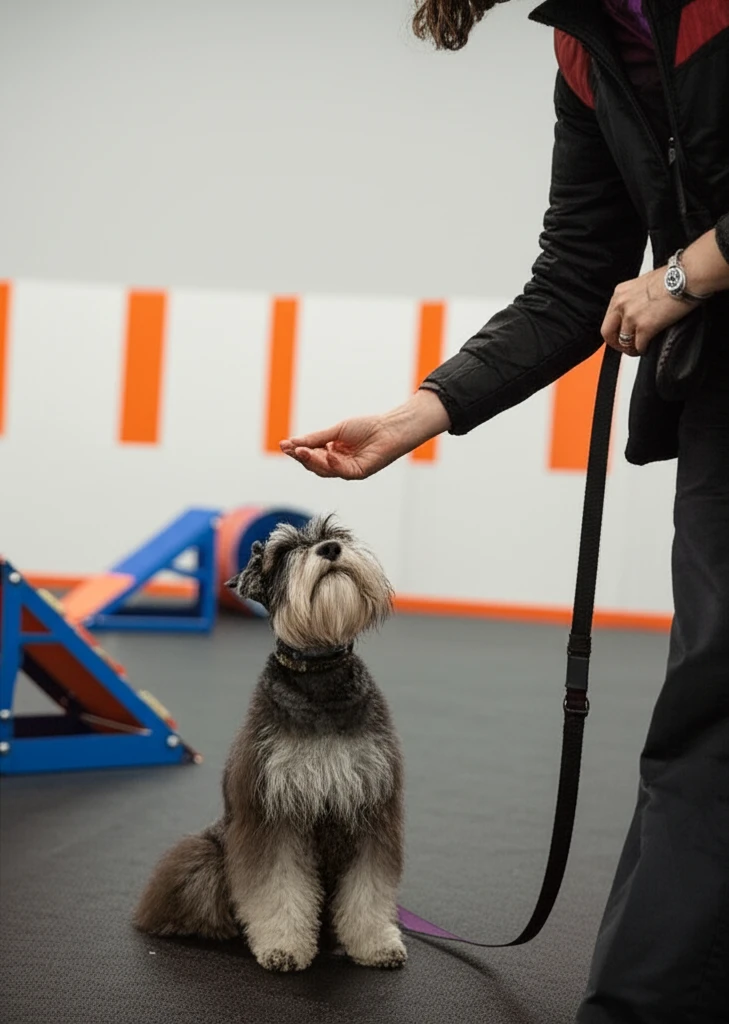
A sit and eye contact. Many trainers use a default sit as the replacement for demand barking. Your dog learns that sitting quietly and looking at you is the thing that makes good stuff happen. Practice this outside of demand barking situations first, reinforcing your dog for choosing to sit and check in with you voluntarily. Then, when they approach you and sit instead of barking, reward that generously.
Going to a mat or bed. If your dog demand barks while you eat dinner, watch TV, or work at your desk, teach them to go to a designated spot and settle. This is an impulse control exercise that gives your dog a clear, rewarded alternative to pestering you. The mat becomes their "I want something" station, and you can check in with them periodically for being there quietly.
Whichever replacement you choose, the key is to be as responsive to the new behavior as your dog's barking trained you to be to the old one. If quiet sitting earns attention just as reliably as barking used to, the switch happens faster than you expect.
Demand Barking vs. Distress Barking: Know the Difference
Not all barking that is directed at you is demand barking. Before you start an extinction protocol, make sure you are not ignoring a dog who is genuinely distressed. Demand barking and distress barking can sound similar, but they come from completely different emotional states, and the intervention for one will make the other worse.
Demand barking is operant. The dog is alert, oriented toward you, and the barking has a rhythmic, insistent quality. The dog's body language is forward and engaged, not fearful. They often pause between barks to see if you are responding. If you leave the room, the barking may stop because the audience is gone. The dog is not in distress. They are working a system.
Distress barking is emotional. It is often higher-pitched, more frantic, and accompanied by other stress signals: panting, pacing, drooling, whining, trembling, or destructive behavior. A dog with separation anxiety who barks when you leave is not demand barking. They are panicking. Ignoring panic does not extinguish it. It makes it worse. If your dog's barking is accompanied by these stress signals, or if it happens primarily when you leave or are about to leave, consult a trainer or veterinary behaviorist who can help you distinguish between the two and build the right plan.
Similarly, a dog who barks because they need to go outside to eliminate is not demand barking. They are communicating a genuine need. If you have not yet taught your dog an alternative signal for needing a bathroom break (like ringing a bell or going to the door), the bark is the best tool they have. Teach the alternative signal first, then address the demand barking that remains.
Setting Your Household Up for Success
Demand barking thrives on inconsistency. If you ignore the barking but your partner responds, your dog learns that barking works on some people and not others, and they will simply bark harder at the person who sometimes gives in. Everyone in the household needs to be on the same page: no attention for barking, immediate attention for the replacement behavior.
Prevention is easier than rehabilitation. If you are raising a puppy or have recently adopted a dog, start now by not responding to barking. Respond to quiet behavior instead. When your dog sits calmly near you, give them attention. When they bring a toy and wait, play with them. When they lie down at your feet while you work, drop a treat. You are building a dog who has learned from the beginning that calm behavior earns engagement and barking does not.
Enrichment reduces demand barking by addressing the underlying need that drives it. Many dogs demand bark because they are bored, under-stimulated, or not getting enough social interaction. A dog who has had a training session, a food puzzle, and a walk is less likely to stand in the kitchen barking at you than a dog who has been lying on the couch all day with nothing to do. Positive reinforcement training sessions, even five minutes a few times a day, give your dog a constructive way to earn your attention and engage their brain.
If demand barking is deeply entrenched and your extinction attempts keep failing because the household cannot stay consistent, structured classes can help. At Zoom Room, you work alongside your dog in a guided environment where you practice the replacement behaviors, learn the mechanical skills of timing your reinforcement correctly, and get coaching through the hard parts. Find a Zoom Room near you to get started.
Frequently Asked Questions
How long does it take to stop demand barking?
It depends on how long the behavior has been practiced and how consistent you are with the extinction protocol. Most dogs show a significant decrease within two to four weeks if every person in the household completely withholds attention for barking and consistently reinforces the replacement behavior. The first few days are the hardest because of the extinction burst, where the barking temporarily gets louder and more persistent. If you can get through that initial escalation without responding, progress accelerates. If household members occasionally give in, the process can take much longer or stall entirely.
My dog barks at me while I'm on the phone or in meetings. How do I handle that?
This is one of the most common demand barking scenarios because your dog has learned that phone calls or video meetings predict a captive audience. You cannot get up and leave, so the barking is more likely to get a verbal response. Prepare in advance: give your dog a long-lasting chew, a stuffed frozen Kong, or a food puzzle before the call starts. Practice the settle-on-a-mat exercise during non-call times so your dog has a trained behavior for these moments. If your dog barks during the call, do not acknowledge it. Reward them during any quiet moments after the call ends. Over time, calls become a cue for mat time rather than a trigger for barking.
Is demand barking the same as alert barking at the door?
No. Demand barking is directed at you to get a specific response, like attention, food, play, or access to something. Alert barking is triggered by an environmental stimulus, like a doorbell, a person walking past, or a noise outside, and its function is to announce the stimulus. The body language is different too: a demand barking dog is focused on you, while an alert barking dog is oriented toward the trigger. They require different interventions. Alert barking responds well to a structured acknowledge-and-redirect protocol. Demand barking responds to extinction paired with teaching an alternative way to ask for what the dog wants.
Ready to Break the Barking Cycle?
Zoom Room's trainers help you understand why your dog demand barks and teach you how to reinforce the quiet behaviors you actually want. You work alongside your dog in a structured indoor gym with real-time coaching.
Find a Zoom Room