
Your First Dog Training Class: What to Expect, What to Bring, and Why Your Dog Does Not Need to Be Perfect
You signed up for a training class, and now you are nervous. Maybe you are worried your dog will be the worst one there, or that everyone else will know what they are doing, or that your dog will bark the entire time. Take a breath. Every single person in that room felt the same way before their first class. Here is what actually happens.
What to Bring (And What to Leave at Home)
Bring these: Your dog on a standard flat collar or harness with a four-to-six-foot leash. A treat pouch loaded with small, soft, high-value training treats. "High-value" means something your dog finds genuinely exciting, not the same kibble they get at every meal. Small pieces of chicken, cheese, hot dog, or commercial training treats that are soft enough to eat quickly all work well. You will use more treats than you expect, so bring plenty. A water bowl and water for your dog. Poop bags. And shoes you can move in, because you will be walking, turning, and positioning your body throughout the class.
Leave these at home: Retractable leashes, which give you no control in a group setting and can cause injuries. Prong collars, choke chains, and shock collars, which are not permitted in positive reinforcement training facilities and are not effective teaching tools. Toys and squeaky balls, which will distract every dog in the room, not just yours. And your expectations of a perfectly behaved dog. That is specifically what you are there to build.
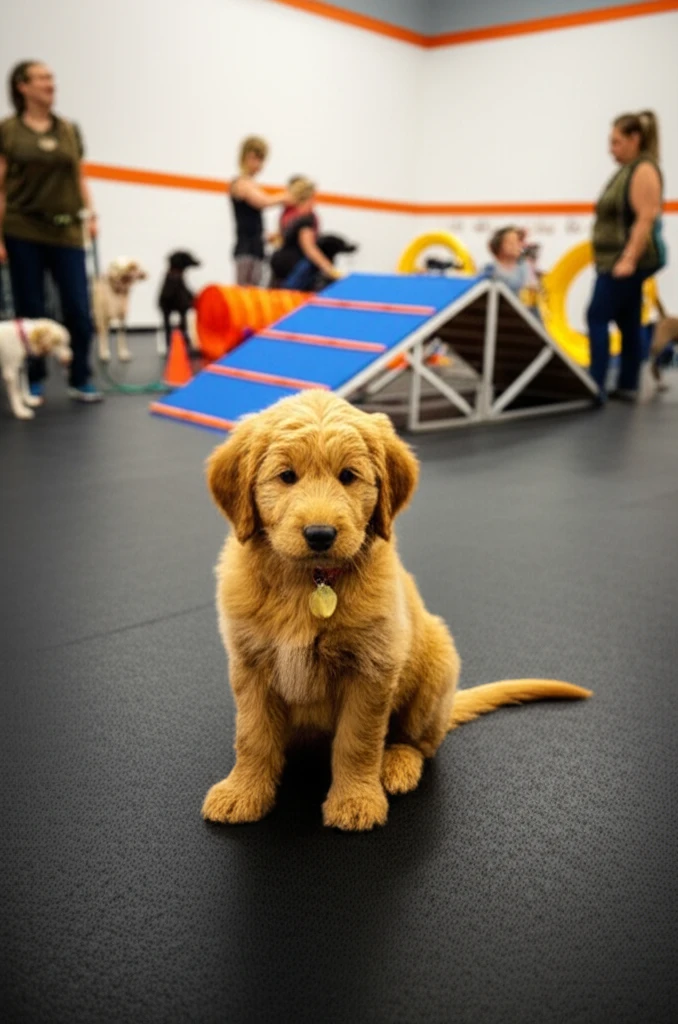
At Zoom Room, our classes are held in a clean indoor gym with rubber matting, good ventilation, and enough space for every dog-and-handler team to work comfortably. The controlled indoor environment means no squirrels, no passing dogs, and no unexpected distractions. This matters because it lets your dog focus on learning rather than scanning for threats or excitement.
What Actually Happens in a Group Class
If you have never been to a dog training class, you might picture a drill sergeant barking orders while rows of dogs sit at attention. That is not how modern, positive reinforcement classes work.
A typical group class session begins with a brief introduction or review from the trainer. You will learn one or two new skills per session. The trainer demonstrates with a volunteer dog or explains the technique, and then every handler practices with their own dog while the trainer circulates, watches, and provides individual coaching. You might spend five minutes practicing a skill, then get a quick break where your dog can decompress, and then practice the next skill.
The skills build on each other week to week. Early classes focus on foundational behaviors: getting your dog's attention, luring into a sit, introducing a marker word or clicker, beginning leash skills. Later sessions layer in more complex behaviors, duration, distance, and distraction around those foundational skills. By the end of a beginner course, you will have a toolkit of cues and techniques that you can practice and build on at home.
At Zoom Room, you are in the room working alongside your dog for the entire class. You are not dropping your dog off or watching from behind glass. This is intentional, because the skills your dog needs to learn are really skills you both need to learn. The trainer is coaching you as much as they are training your dog. You learn the timing, the mechanics, and the why behind every technique, so you can replicate it in real life. The relationship you build in that room, the teamwork, the communication, the trust, is the whole point.
What to Expect From Your Dog (Honestly)
Your dog has never been in a room full of other dogs and people trying to learn something. The environment is new, the smells are new, and the stimulation level is high. Here is what is completely normal for a first class.
Distraction. Your dog may spend most of the first class looking at every other dog in the room instead of at you. This is normal. They are processing a lot of new information. Their attention will improve as the environment becomes familiar over the next few sessions.
Excitement. Some dogs arrive in a state of high arousal: pulling on the leash, whining, trying to get to every other dog and person. This is not bad behavior. It is a dog who finds the world exciting and has not yet learned impulse control. The class will help you build that skill.
Shutting down. Some dogs go the opposite direction. They tuck their tail, flatten their body, or refuse to take treats. This is a stress response, and it does not mean your dog is not trainable. It means the environment is overwhelming right now. A good trainer will notice this and help you find the right distance, pace, and approach to help your dog engage without pushing them past their threshold. If your dog has a history of fear-based behavior, let the trainer know before class so they can support you.
Barking. Your dog might bark at other dogs, at the trainer, at the air. Some dogs bark when they are frustrated, excited, or uncertain. It can feel mortifying when your dog is the loudest one in the room, but trainers expect it. They have seen thousands of dogs in their first class, and yours is not the first barker. Management strategies and training techniques will be part of the process.
Not performing. Your dog might not sit, not look at you, and not take a single treat. That is fine. Learning happens at different speeds, and the first class is as much about exposure as it is about skill acquisition. Many dogs who appear to learn nothing in class one suddenly perform beautifully at home, because they were processing the experience even when they were not visibly responding.
What to Expect From Yourself
Here is the part nobody talks about: you are a student too, and the learning curve is real. Training a dog requires mechanical skills that feel awkward at first. You are managing a leash in one hand, treats in the other, trying to time a marker word at the exact right moment, positioning your body correctly, and interpreting your dog's body language all at once. You will fumble. Your timing will be off. You will lure in the wrong direction or click a second too late. That is normal, and it improves with practice.
You will also compare yourself to other handlers. The person whose dog sits perfectly on the first try. The person whose dog walks in a beautiful heel. Remember that you have no idea whether that is their first class or their fifth dog. And even if it is their first class, your dog is not their dog. Every dog comes in with a different temperament, a different history, and a different set of things they find motivating or challenging.
The most important thing you can do in your first class is listen, try the techniques, and not worry about how you look. Your dog does not care if you are graceful. They care that you are present, that you have treats, and that the experience is positive. The positive reinforcement approach works for people too: focus on what you got right in each session, not what you got wrong.
Ask questions. That is what the trainer is there for. If something does not make sense, or if you cannot get a technique to work with your specific dog, speak up. A good trainer will offer alternative approaches, adjust the exercise, or break the skill into smaller steps. Zoom Room classes are capped in size so the trainer has time to work with each team individually.
What Happens After Class One
The real training happens between classes, at home, on walks, and in daily life. Each class gives you new skills to practice, and the practice between sessions is what turns those skills into reliable behaviors. Short sessions work better than long ones. Five minutes of focused practice three times a day is more effective than one 30-minute session where both you and your dog lose focus.
You will likely notice progress unevenly. Your dog might nail the recall at home but completely ignore you at the park. They might sit perfectly in the kitchen but act like they have never heard the cue in the backyard. This is normal. Dogs do not generalize well, meaning a behavior learned in one context does not automatically transfer to another. Part of the training process is practicing each skill in gradually more distracting environments until it becomes reliable anywhere.
Most beginner programs run four to eight weeks, and by the end, you will have a foundation of communication and cooperation with your dog that changes your daily life. Socialization, leash skills, attention cues, basic manners, and the beginning of impulse control give you the tools to navigate real-world situations with confidence.
Many handlers find that the first class is the beginning of something they did not expect to enjoy as much as they do. Training with your dog is a collaborative activity that strengthens your bond, challenges you both, and builds mutual trust. It is not a chore you do to fix your dog. It is a shared skill you develop together.
If you have been putting off enrolling because you think your dog is not ready, or because you are not sure what to expect, now you know. Your dog does not need to be ready. You do not need to be experienced. You just need to show up with treats and a willingness to learn. Find a Zoom Room near you and book your first class.
Frequently Asked Questions
Can my dog start training classes if they do not know any cues yet?
Absolutely, and that is the expectation for a beginner class. Your dog does not need to know sit, down, stay, or anything else before enrolling. Beginner classes are designed to teach these skills from scratch, starting with the fundamentals of how your dog learns and how you communicate with them. Bringing a completely untrained dog to a beginner class is exactly what the class is for. If your dog does already know some basics, the class will refine those skills and build on them in a structured environment with professional guidance.
My dog is reactive to other dogs. Should I wait before signing up for a group class?
Do not wait. Avoidance does not improve reactivity, and group classes in a controlled environment are one of the most effective settings for working on it. Let the training facility know about your dog's reactivity when you register so the trainer can prepare. In a well-managed class, dogs work at enough distance from each other that reactive dogs can be under their threshold while still building skills. At Zoom Room, our trainers are experienced with reactive dogs and will help you manage distance, use high-value treats for counter-conditioning, and build your dog's ability to focus near other dogs gradually. Starting classes is how the reactivity gets better.
How do I choose between a group class and private training?
Group classes are ideal for most dogs and owners because they provide socialization, controlled distractions, and a learning environment that mimics real-life scenarios. The presence of other dogs is not a drawback. It is a feature. Your dog needs to learn to focus and respond to cues around other dogs and people, and a group class builds that skill from the start. Private sessions are useful for specific behavioral issues that need individualized attention, like severe reactivity, separation anxiety, or fear-based aggression, or for owners who want focused coaching on a particular skill. Many people do both: group classes for socialization and foundational training, and occasional private sessions for targeted problem-solving.
Ready to Get Started?
Your first Zoom Room class is the beginning of a training partnership that changes how you and your dog navigate the world together. No experience required, just treats and a willingness to learn.
Find a Zoom Room