
Off-Leash Dog Training: How to Build Reliable Freedom Safely
Off-leash reliability is the pinnacle of dog training. It means your dog chooses to come back to you, stay near you, and follow your guidance even when the entire world is right there, unleashed and full of squirrels. Most dogs are not there yet, and the honest truth is that some dogs may never be fully off-leash safe. But understanding what it takes to get there, and how to build toward it responsibly, is worth every owner's time.
The Prerequisites Most People Skip
Off-leash freedom is not a training goal you jump straight to. It sits on top of a stack of foundational skills that each need to be solid before the leash comes off. Skipping those foundations is how dogs get lost, injured, or create dangerous situations for themselves and others.
The first prerequisite is a rock-solid recall. Your dog must come to you immediately, reliably, and under distraction. Not a casual trot in your direction when they feel like it. An immediate, fast, enthusiastic return the first time you call, even when there is a rabbit running the other way. This level of recall takes months of dedicated training and proofing in dozens of different environments. A recall that works in your backyard but fails at the beach is not an off-leash recall. It is a backyard recall, and the distinction matters when your dog is 200 feet away and heading toward a road.
The second prerequisite is impulse control. A dog who cannot resist chasing a squirrel on leash is not going to resist off leash. Impulse control is what keeps your dog from bolting after a cyclist, rushing up to a strange dog, or disappearing into the woods after a deer. It is the ability to acknowledge a temptation and choose not to pursue it, and it is built through systematic training, not willpower.
The third is environmental awareness and engagement with you. An off-leash dog needs to check in with you voluntarily, not just respond when called. They should glance back at you regularly, orienting to your position and pace without being told. This is what trainers call engagement, and it means your dog sees you as the most relevant thing in the environment, not the least interesting one.
If any of these three skills are missing or unreliable, your dog is not ready for off-leash work. That is not a judgment. It is a safety assessment. Build the foundation first.
The Long-Line Progression
The long line is the bridge between on-leash and off-leash, and it is the most important tool in the off-leash training process. A long line is a lightweight, 15 to 50 foot leash that gives your dog the feeling of freedom while maintaining your ability to intervene. It is how you proof your recall and impulse control in real-world environments without risking your dog's safety.
Start with a 15-foot long line in a low-distraction environment. Practice recall at the full length of the line. If your dog comes every time, increase the distractions: practice near a park where other dogs are visible at a distance, near a walking path where joggers pass, near a wooded area with interesting smells. The long line is your insurance policy. If your dog does not respond to the recall, you have a physical connection. You do not yank the line. You gently prevent your dog from self-rewarding by reaching the thing they were ignoring you for, then re-engage and try again.
Progress to a 30-foot, then 50-foot long line. At each length, rebuild reliability before increasing distance. Let the line drag rather than holding it, so your dog has the sensation of being free while you can still step on the line if needed. Practice in multiple environments: fields, beaches, trails, parking lots. Each new environment partially resets the difficulty because the distractions are different.
The long line phase should last weeks to months, not days. This is where most people get impatient. They practice recall on a long line for a week, it looks good, and they unclip. Then the dog sees a deer and they discover that their recall was only reliable when the leash was attached because the dog knew the difference. Dogs are excellent at discriminating between leashed and unleashed states. The long line, dragging on the ground where the dog forgets about it, is what bridges that gap.
When your dog's recall on a dragging 50-foot long line in a high-distraction environment is as reliable as it is on a six-foot leash in your backyard, you are approaching off-leash readiness. Not before. Cut the line shorter gradually: 30 feet, then 15, then a short drag tab. Then off.
Breed Realities and Individual Limits
Here is the uncomfortable truth that many off-leash training programs gloss over: some dogs, because of breed, individual temperament, or both, may never be reliably safe off leash in uncontrolled environments. Acknowledging this is not giving up. It is responsible ownership.
Breeds with high prey drive, including most sighthounds like Greyhounds, Whippets, and Afghan Hounds, scent hounds like Beagles, Bloodhounds, and Bassets, and many terrier breeds, were genetically selected to pursue prey independently. Their drive to chase is not a training problem. It is a feature of their breed that has been refined over centuries. A Greyhound who spots a rabbit at 200 yards is running a program that was hard-coded by generations of selective breeding, and no amount of recall training is likely to override it in that moment. Can you build a strong recall in these breeds? Absolutely. Can you guarantee it will hold when the ultimate distraction appears? You cannot, and pretending otherwise puts the dog at risk.
Individual temperament matters as much as breed. A Labrador Retriever with excellent handler focus and moderate prey drive might be an off-leash candidate. A Labrador with intense bird drive who loses all awareness when a flock takes off might not. Assess your individual dog honestly, not the idealized version of their breed you read about online.
Age and life stage affect reliability too. Adolescent dogs, roughly six to 18 months, go through developmental periods where previously solid skills become unreliable because their brains are rewiring. An adolescent dog who had a perfect recall at five months may blow you off entirely at ten months. This is not a training failure. It is a developmental phase, and it is the worst possible time to introduce off-leash freedom. Wait until your dog has matured through adolescence and their training is solid again.
A dog who is not off-leash safe in an uncontrolled environment can still enjoy significant freedom. Long lines, reliable leash skills, fenced parks, and rented private dog fields all provide room to run without the risks of true off-leash exposure. There is no shame in a dog who lives a full, happy life on leash.
Why Aversive Tools Are Not the Shortcut They Promise
The most common pitch for e-collars (shock collars, remote trainers) in the off-leash context is that they provide a reliable correction at a distance, ensuring your dog returns when called even under high distraction. The reality is more complicated and less favorable than the marketing suggests.
An e-collar creates compliance through discomfort avoidance. The dog learns to come back not because they want to be with you, but because not coming back predicts an aversive sensation. This can produce the appearance of reliability in the short term, but it comes with risks that are well documented in behavioral science. Dogs trained with aversive methods are more likely to develop anxiety, fear, and aggression, both in general and specifically toward the triggers that were present when the correction occurred. A dog who receives a shock while looking at another dog may develop leash reactivity toward other dogs. A dog corrected for chasing a squirrel may generalize the fear to the park itself.
The other problem is that compliance under aversive control is context-dependent. Dogs are excellent at learning when corrections are possible and when they are not. A dog who recalls perfectly with the e-collar on may ignore you entirely when it is off, because the collar, not the cue, was the real signal. This is the opposite of genuine reliability.
Positive reinforcement builds recall motivation through desire, not fear. A dog who comes racing back to you because your recall cue predicts a jackpot of treats, play, or freedom to go explore again is a dog whose recall is fueled by joy. That kind of motivation is more robust, more transferable, and more resistant to distraction than compliance based on discomfort avoidance. It takes longer to build, which is why aversive tools are tempting. But the training built on positive reinforcement is more reliable, produces a healthier dog, and does not carry the risk of behavioral fallout.
Liability, Laws, and Responsible Off-Leash Practice
Before you unclip the leash, know the legal landscape. Most cities and counties have leash laws that require dogs to be leashed in public spaces outside of designated off-leash areas. Violating these laws can result in fines, and if your off-leash dog injures someone, damages property, or causes a traffic accident, you are legally liable regardless of how well trained your dog is. "My dog is friendly" is not a legal defense.
Even in designated off-leash areas, you are responsible for your dog's behavior. If your dog knocks someone down, starts a fight with another dog, or chases wildlife, the consequence falls on you. Off-leash freedom is a privilege that requires your dog to be under reliable voice control, and it requires your honest assessment of whether that control exists in a given environment on a given day. A dog who was perfectly responsive yesterday but is overstimulated by a large group of dogs today should be leashed. Moment-to-moment judgment is part of responsible off-leash practice.
Consider the other people and dogs sharing the space. Not everyone is comfortable around off-leash dogs, and they do not need to be. People with fearful or reactive dogs on leash, children who are afraid of dogs, joggers who do not want to be chased, and wildlife that deserves to exist without being harassed all have a legitimate claim to shared spaces. Your dog's desire to run free does not override their right to safety and comfort.
If your dog is truly off-leash ready, enjoy that freedom responsibly. Keep your dog in sight at all times. Carry treats for reinforcing check-ins and recalls in the real world. Call your dog back and reward them frequently, not just when it is time to leave. Every recall in the field that ends with a reward makes the next recall more reliable. And always, always have a leash with you. Conditions change, and a responsible off-leash handler knows when to clip up.
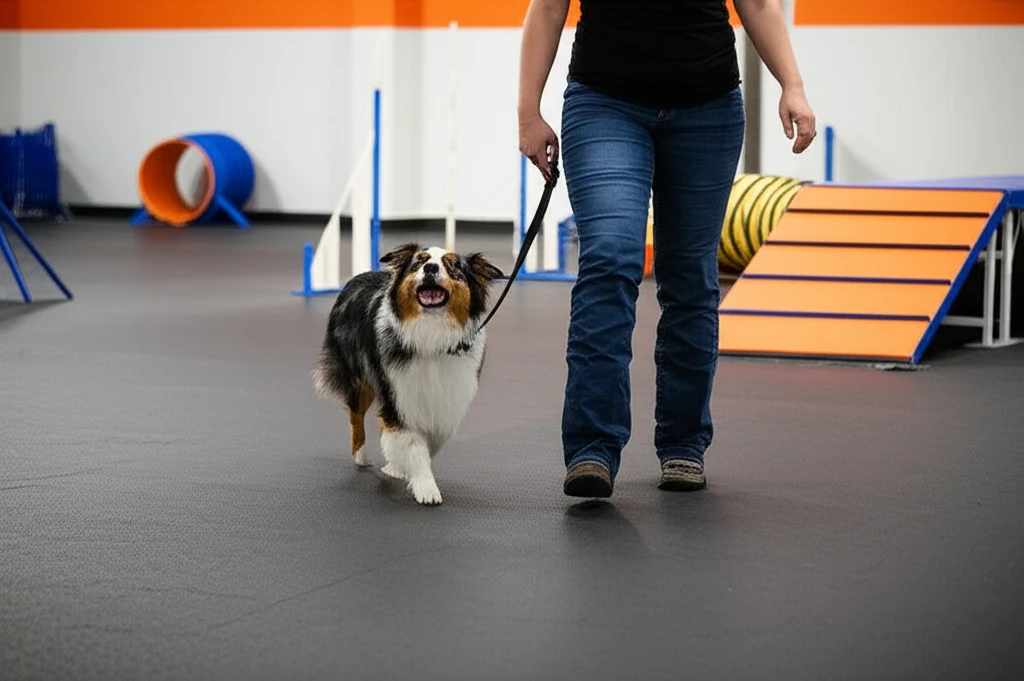
Find a Zoom Room near you to build the recall, impulse control, and engagement skills that make off-leash reliability possible. Our indoor gym provides a controlled environment where you can proof your dog's skills before taking them into the unpredictable real world.
Frequently Asked Questions
At what age can I start off-leash training?
You can start building the foundation skills at any age, but actual off-leash freedom in uncontrolled environments should wait until your dog is past adolescence, generally 18 months to two years for most breeds. Puppies can practice recall and impulse control on a long line from a young age, and this early work is invaluable. But adolescent dogs go through developmental phases where previously reliable skills become unpredictable, and the risk of your dog blowing off a recall during this period is too high for off-leash work. Build the skills early, proof them thoroughly during adolescence on a long line, and transition to off-leash only when your dog has matured and the skills are consistently reliable across environments.
How do I know if my dog is ready to go off leash?
Your dog is approaching readiness when they meet all three criteria: a recall that works the first time in high-distraction environments on a dragging long line, impulse control around real-world temptations like squirrels, other dogs, and joggers, and voluntary check-ins where they look back at you regularly without being called. If your recall fails more than once out of ten attempts in a distracting environment, or if your dog has ever blown past you to chase something while on a long line, they are not ready. Proof the skills further before removing the safety net. Be honest with yourself. The cost of overestimating your dog's readiness is too high.
My dog comes when called at home but ignores me at the park. What am I doing wrong?
Nothing is wrong. You have simply not generalized the recall to a high-distraction environment yet. Dogs do not automatically transfer skills learned in one context to another. A recall that works in your living room needs to be practiced and reinforced in the backyard, then on a quiet street, then at a park with mild distractions, then at a park with significant distractions. Each new environment is a partial reset. Use a long line at the park and practice recall with extremely high-value rewards, treats that are better than anything the environment is offering. Increase the distraction level gradually and do not advance until the current level is reliable. The park recall will come, but it takes dedicated practice in that specific setting.
Ready to Build Off-Leash Reliability?
Zoom Room's recall training, impulse control classes, and obedience programs build the foundation your dog needs for reliable off-leash behavior. Our indoor gym gives you a controlled space to proof skills before testing them in the real world.
Find a Zoom Room