
How to Train a Boxer
Boxers are the dogs who never fully grow up. That playful, bouncy, full-throttle energy that's so charming in a puppy is still there at age five, attached to sixty or seventy pounds of muscle. Training a Boxer means working with that energy, not against it.
The Jumping Problem (And Why It's Your First Priority)
Boxers jump. On you, on your guests, on strangers at the park, on anyone who makes eye contact. This isn't a minor annoyance — it's a sixty-pound dog launching themselves at chest height, and it's the number one complaint from Boxer owners by a wide margin. It matters because a jumping Boxer can knock over a child, injure an elderly person, or simply make every greeting into a stressful wrestling match.
The reason Boxers jump is straightforward: they're excited to see people, and jumping gets them closer to faces. The fix isn't to punish the jumping. It's to make four-on-the-floor more rewarding than going airborne. Teach an incompatible behavior — a Boxer who is sitting cannot simultaneously jump. Ask for a sit before every greeting, every meal, every leash clip. Reward the sit generously. When your Boxer jumps, turn away completely and withdraw attention. No eye contact, no talking, no pushing them down (which most Boxers interpret as play).
Consistency from every person your Boxer encounters is critical. If one guest lets your Boxer jump while you're trying to train an alternative, you've just taught your dog that jumping works sometimes. Check out our guide on how to stop dog jumping for a detailed protocol that works well with Boxers specifically.
Training a Dog Who Thinks Everything Is a Game
Boxers approach training the way they approach everything else: with enthusiasm, physical energy, and a sense of humor. This is a breed that will grab a treat, do a victory lap around the room, and then come back for more. That exuberance is endearing, but it can make structured training feel like herding cats.
Positive reinforcement is the clear choice for Boxers, and not just because it's kind. Boxers are sensitive dogs who read their owner's energy with surprising accuracy. A harsh correction doesn't produce compliance — it produces a confused dog who either shuts down or gets more wound up. But a Boxer who understands the rules of the game? They'll work their heart out for you.
Keep training sessions energetic but focused. Use movement-based rewards alongside treats — a quick tug game or a short chase can be more motivating for a Boxer than food alone. Break skills into small steps so your Boxer gets frequent wins. And build in a "release" cue that lets them be goofy for a moment between reps. Trying to make a Boxer hold still for twenty minutes of focused work is a losing battle. Two minutes of engagement, a brief release, then back to work — that's the rhythm.
Heat Sensitivity and the Indoor Training Advantage
Boxers are brachycephalic — they have shorter muzzles that make breathing less efficient, especially in warm weather. This isn't just a health consideration. It directly affects training. A Boxer who is overheating can't focus, can't perform, and is at risk for heat-related illness. If you've ever tried to train your Boxer in a park on an August afternoon and wondered why they were sluggish and distracted, this is probably why.
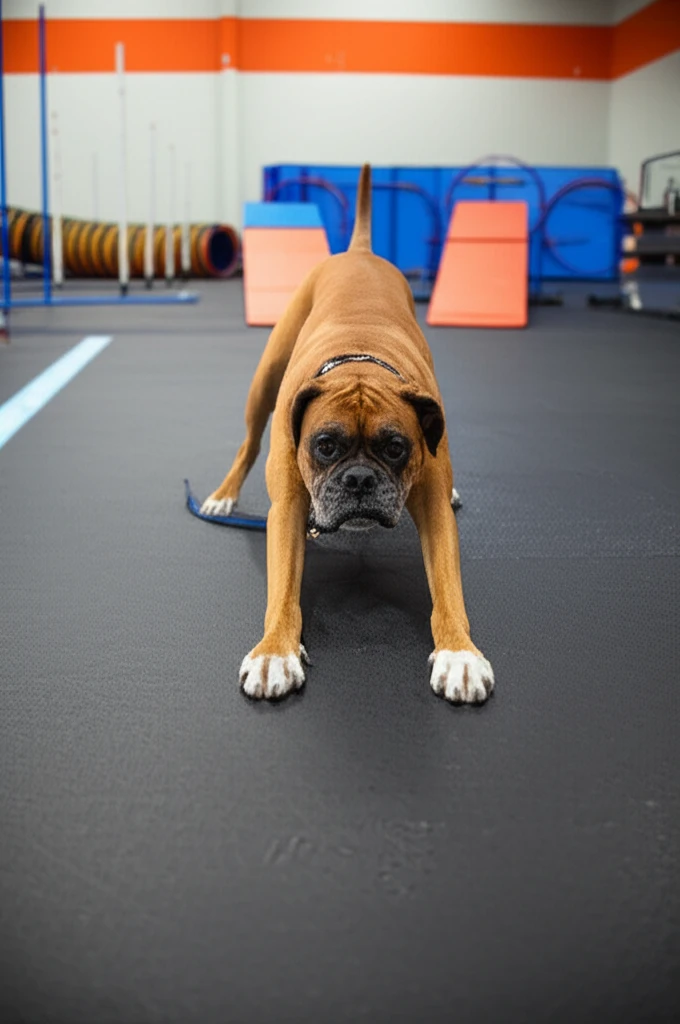
Indoor training solves this problem entirely. A climate-controlled indoor training facility means your Boxer can work at full capacity year-round without weather limitations. No canceled classes because it's too hot. No shortened sessions because your dog is panting after five minutes. This is one of the reasons Boxers do exceptionally well in Zoom Room's indoor environment — the temperature is consistent, and your dog can train comfortably regardless of what's happening outside.
Even at home, be mindful of your Boxer's breathing during training sessions. If they're panting heavily, take a break. Provide water and cool-down time. Schedule outdoor training for early morning or evening during warmer months.
Leash Manners: Start Early, Stay Consistent
A Boxer on a leash can feel like being towed by a very enthusiastic boat. They're strong, muscular, and have a center of gravity that makes pulling remarkably effective. If you wait until your Boxer is full-grown to address leash manners, you're trying to retrain a deeply ingrained habit in a dog who weighs more than some adults.
Start leash training the day your Boxer puppy comes home. Reward walking near you with treats and praise. Stop moving the instant the leash goes tight — your Boxer learns that pulling makes the walk stop, and loose leash makes the walk continue. Front-clip harnesses can help manage pulling while you train, but they're a management tool, not a permanent solution. The goal is a dog who chooses to walk with you because it's more rewarding than forging ahead.
If your Boxer is already a confirmed puller or shows leash reactivity toward other dogs, group classes provide the perfect training ground. Your Boxer practices walking politely with real-world distractions — other dogs, people, activity — in a controlled setting where a trainer can guide your technique in real time. Socialization programs at Zoom Room include leash skills as a core component.
Socialization: Channeling the Social Butterfly
Boxers generally love other dogs and people, which sounds like socialization should be easy. The challenge isn't that Boxers are wary — it's that they're so enthusiastic about social interactions that they overwhelm other dogs. A Boxer's play style involves body-slamming, face-pawing, and full-speed charges that not every dog appreciates. Without learning appropriate social skills, your Boxer's good intentions can start fights.
Structured socialization teaches your Boxer how to read other dogs' body language and modulate their own energy. They need to learn that not every dog wants to play at maximum intensity, and that taking a break when another dog signals discomfort is part of being a good social citizen. This is something that group classes teach organically — your Boxer practices being around other dogs while learning to maintain focus on you.
Solid recall is especially important for Boxers because of their social enthusiasm. You need to be able to call your Boxer back when they're locked onto another dog from across the park. Train recall in progressively distracting environments, starting indoors and building up to outdoor settings with other dogs present. Find your nearest Zoom Room to start building the foundation your Boxer needs for a lifetime of good social skills.
Frequently Asked Questions
At what age do Boxers calm down?
Boxers typically begin to settle around three to four years old, but many retain a playful, high-energy disposition well beyond that. Waiting for your Boxer to calm down on their own isn't a training strategy. What actually produces a calmer dog is consistent training, adequate mental stimulation, and regular exercise. A Boxer with a solid training foundation and appropriate outlets for their energy is manageable at any age. The goal isn't to eliminate the energy — it's to teach your Boxer how to channel it appropriately.
Are Boxers good with other dogs?
Boxers are typically very social and enjoy the company of other dogs. The challenge is that their play style is physical and intense, which can overwhelm or irritate dogs who prefer calmer interactions. Proper socialization teaches your Boxer to read social cues from other dogs and adjust their energy accordingly. Group training classes are ideal for this because your Boxer learns to coexist with other dogs in a structured setting. With good socialization, most Boxers are excellent with other dogs of all sizes.
Why does my Boxer jump on everyone?
Boxers jump because they're excited and want to be closer to faces — it's a greeting behavior driven by genuine enthusiasm, not a dominance display. The behavior persists because it gets a reaction. Even pushing your Boxer off or saying "no" is attention, which reinforces the jumping. The most effective approach is to teach an alternative greeting behavior like sitting, reward that behavior consistently, and completely withdraw attention when your Boxer jumps. Every person your Boxer greets needs to follow the same protocol, or the jumping will continue intermittently.
Ready to Get Started?
Zoom Room's climate-controlled indoor gym is ideal for Boxers — no heat concerns, no weather cancellations, and professional trainers who know how to channel that Boxer energy. Find a location near you.
Find a Zoom Room