
How to Train a Miniature Schnauzer
Miniature Schnauzers are sharp, spirited dogs who will alert you to every delivery truck, passing squirrel, and shifting shadow outside your window. Training one means channeling that watchdog intensity into something productive before your neighbors start leaving notes on your door.
Why Your Miniature Schnauzer Barks at Everything
Miniature Schnauzers were bred as ratters and farm watchdogs in Germany. Their job was to notice things and sound the alarm. When your Schnauzer erupts at the mail carrier, a dog across the street, or a noise three rooms away, that is not a behavior problem in the traditional sense. It is a breed doing exactly what it was designed to do, in a context where nobody asked for it.
The barking is the number one reason Schnauzer owners seek training help. Addressing excessive barking in this breed requires understanding that you are working against centuries of selective breeding. You will not eliminate the alert instinct, and you should not try. Instead, teach an "enough" or "thank you" cue: acknowledge the alert, reward the quiet, and redirect. Your Schnauzer needs to know that you heard the information and handled it. Without that feedback loop, they will keep escalating because, from their perspective, you are ignoring critical intelligence.
Training a Schnauzer Brain
Miniature Schnauzers are genuinely smart, and that intelligence comes with opinions. You will notice your Schnauzer scanning situations, making calculations, and occasionally deciding that your cue is not the most interesting option available. This is not defiance. It is a dog with a high cognitive load evaluating whether the reinforcement you are offering is worth the effort.
The fix is straightforward: make training worth their time. Schnauzers respond exceptionally well to positive reinforcement when the rewards are high value and the sessions are short and varied. Five minutes of focused work with real chicken beats twenty minutes of repetitive drills with dry kibble. They also excel at problem-solving tasks, so rotate through different exercises rather than hammering the same cue. Clicker training works particularly well with this breed because it gives them precise feedback, and Schnauzers are wired to process precise information.
Keep sessions unpredictable. If your Schnauzer can predict the entire training sequence, they will get bored and start freelancing. That is when the barking, digging, and creative mischief tend to fill the gap.
Socialization: Preventing the Territorial Spiral
An under-socialized Miniature Schnauzer tends to become a territorial one. Without controlled exposure to unfamiliar people, dogs, and environments, their natural alertness hardens into reactivity. The dog who barks at the doorbell becomes the dog who lunges on leash at anyone who walks too close.
Early and ongoing socialization is essential for this breed. The goal is not to make your Schnauzer love every stranger. It is to build enough confidence that new experiences register as interesting rather than threatening. In a controlled indoor setting, your Schnauzer can encounter new dogs and people at a manageable pace, with you right there reinforcing calm behavior.
Pay special attention to how your Schnauzer responds to people entering your space. Practice having friends come through the door while you reward four-on-the-floor behavior. If guests are consistently paired with good things, the doorbell becomes a positive predictor rather than a trigger for an alarm response.
Exercise and Mental Engagement
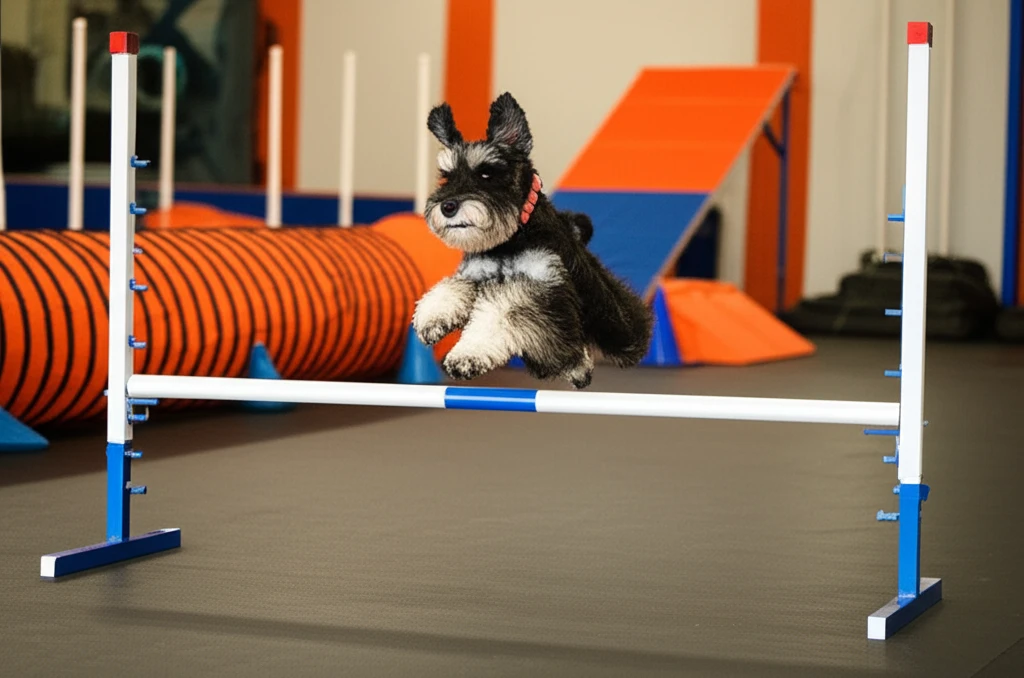
Miniature Schnauzers are more athletic than their size suggests. They have terrier energy without terrier stubbornness about direction, which makes them excellent candidates for structured activities like agility. The combination of physical movement and problem-solving in an agility course is almost perfectly matched to what a Schnauzer brain needs.
A Schnauzer who gets adequate mental and physical work is dramatically easier to live with. The barking decreases, the territorial behavior softens, and the creative destruction drops off. An indoor training gym gives you a controlled space to channel that energy productively, regardless of weather or neighborhood distractions. Consider working toward a Canine Good Citizen certification as a structured goal that covers all the real-world skills your Schnauzer needs.
Daily enrichment does not have to be complicated. Scatter feeding, snuffle mats, and short training sessions throughout the day keep that busy Schnauzer brain occupied. A mentally tired Schnauzer is a quiet Schnauzer.
Living with the Schnauzer Personality
Miniature Schnauzers bond deeply with their people and want to be involved in household activity. Use that to your advantage. Include your Schnauzer in daily routines and make real-life rewards part of your training. Sit before meals, wait at doors, settle on a mat while you cook. These are not tricks. They are life skills that give your Schnauzer a role in the household that does not involve being the security system.
If you have a multi-dog household or are introducing a new dog, manage the introduction carefully. Schnauzers can be selective about their canine companions, especially on their home turf. Neutral-ground introductions and gradual integration work far better than tossing everyone together and hoping for the best.
The Miniature Schnauzer who gets structured training, appropriate socialization, and enough mental work is one of the most rewarding breeds to live with. They are engaged, responsive, and genuinely fun to train. Find a Zoom Room near you to get started with a breed who is always ready to learn something new.
Frequently Asked Questions
How do I stop my Miniature Schnauzer from barking so much?
Teach an acknowledgment-based system rather than trying to suppress the bark entirely. When your Schnauzer alerts, calmly say "thank you" or "enough," then redirect and reward the silence. The key is consistency: every bark gets the same calm response, and every moment of quiet gets reinforced. Avoid yelling at your Schnauzer to be quiet, since from their perspective, you are just barking along with them. Increase mental stimulation throughout the day, because a Schnauzer with an occupied brain barks less. If the barking is directed at specific triggers like the doorbell or passersby, work on desensitization to those triggers specifically.
Are Miniature Schnauzers easy to train?
Miniature Schnauzers are highly trainable when you match your approach to how they think. They learn quickly with positive reinforcement, especially when rewards are high value and sessions are short and varied. Where some owners run into trouble is expecting robotic obedience. Schnauzers process information and sometimes make their own assessments before responding. Keep training interesting, use a marker like a clicker for precise feedback, and avoid long repetitive drills. They thrive on novelty and mental challenge, so rotating exercises and building complexity keeps them engaged.
Do Miniature Schnauzers need a lot of socialization?
Yes, socialization is especially important for this breed. Miniature Schnauzers have a natural tendency toward territorial behavior and alertness around strangers. Without regular, positive exposure to new people, dogs, and environments, that alertness can escalate into reactivity. Start socialization early and continue it throughout their life. Focus on controlled environments where you can manage the intensity of new experiences. Group training classes serve double duty here, providing both skill-building and built-in socialization with other dogs and handlers in a structured setting.
Ready to Get Started?
Zoom Room's group classes and agility courses are a perfect fit for the Miniature Schnauzer brain. You train alongside your dog in a clean, indoor gym with a professional trainer guiding every session.
Find a Zoom Room